Roter See, Natural monument and lake in Werra-Meißner-Kreis, Germany.
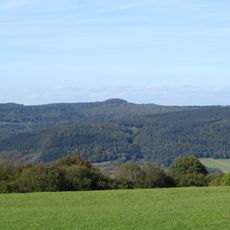
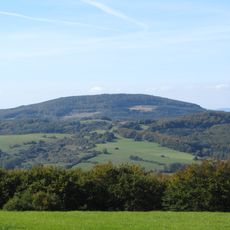
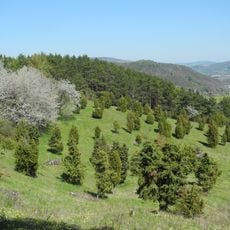
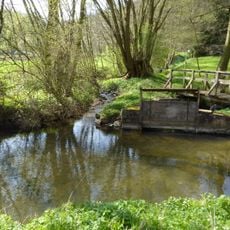
Roter See is a lake situated in the Kaufunger Wald region at roughly 520 meters elevation, surrounded by dense forest. Clear waters and marked hiking trails allow visitors to move through the landscape and observe the woodland setting.
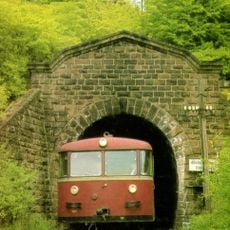
The lake is a flooded basalt quarry at Hesselbühl, abandoned in 1914; the Basaltwerk Hesselbühl-Kaufungen had quarried columnar basalt there since 1898, hauling it by electric field railway via Carmshausen to Witzenhausen for road and railway construction. Until about 1940 the water was brick-red from iron-oxide particles washed from the surrounding Buntsandstein; the colour survives only on old hand-coloured postcards.
The name comes from the water's former brick-red colour, caused by iron-oxide particles from the surrounding Buntsandstein; it was visible until about 1940 and drew watercolour painters, who used the red water, black basalt walls and green summer forest as a motif. A local tale says a lightning strike discharged the suspended colloids and ended the colour. The old colouring survives only on old hand-tinted postcards.
Visitors can reach the area through marked access points and find information boards explaining the local ecology on site. The trails remain accessible throughout the year, though warmer months offer the most comfortable visiting conditions.
The brick-red colour of the water, caused by iron-oxide particles from the surrounding Buntsandstein, was visible until about 1940 and made the lake a motif for watercolour painters. It is said a lightning strike may have discharged the suspended colloids and ended the colour; today only old hand-coloured postcards show it.
The community of curious travelers
AroundUs brings together thousands of curated places, local tips, and hidden gems, enriched daily by 94,535 contributors worldwide.