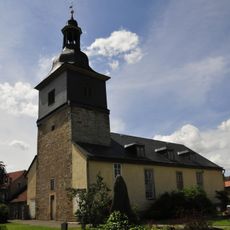
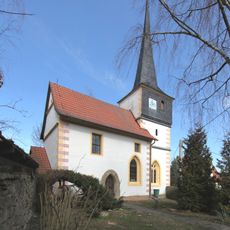
Stiftskirche Römhild, Gothic church in Römhild, Germany.
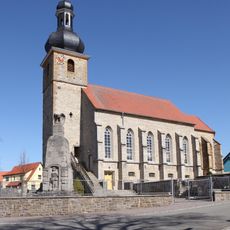
Stiftskirche Römhild is a Gothic hall church with three naves and ribbed vaults that create a sense of vertical space through pillars and arches. The eastern choir holds a grand altar, while a western choir supports the organ above the entrance.
The church was first documented in 1341. In 1450 the Würzburg bishop Gottfried raised it to collegiate status, and a new hall church was built up to 1470 under Count Georg I of Henneberg. From 1465 the Hennebergs used it as their court and burial church; the Reformation was introduced in 1546 under Count Berthold XVI, and after the 1556 visitation the college was dissolved and the church became the town's main parish church.
The baroque altar from 1692 displays the baptism of Jesus with John the Baptist and his disciples in a lively scene. This ornate work continues to shape the interior space and captures visitors' attention with its detailed craftsmanship.
The church stands at the end of the northern aisle beside the east choir, where the roughly 48-metre tower rises; the sacristy occupies the tower's base storey under its own ribbed vault. The west portal's ground floor forms an entrance hall, and a stone inscription above it records the building of the church and the foundation. The 846-title church library, 196 of them printed in the 16th century, is a historical collection rather than a public reading room.
The bronze tombs of the Henneberg counts were cast between 1488 and 1510 in the Nuremberg workshop of Peter Vischer the Elder and his sons, and were moved into the baptismal chapel in 1735. They comprise a statue of Otto IV of Henneberg and the tomb of Hermann VIII of Henneberg and Elisabeth of Brandenburg, bearing 16 coats of arms.
The community of curious travelers
AroundUs brings together thousands of curated places, local tips, and hidden gems, enriched daily by 92,634 contributors worldwide.