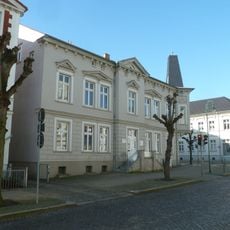
Luisentempel, Neoclassical memorial temple in Schlosspark Neustrelitz, Germany.
The Luisentempel is a classicist memorial hall built in 1891 on an artificial hill at the edge of Schlosspark Neustrelitz. Architect Bernhard Sehring used Silesian sandstone, and the interior is lined with coloured Italian marble. In the centre stands a Carrara marble copy of Christian Daniel Rauch's second version of Queen Luise's sarcophagus, carved by his pupil Albert Wolff.
The Luisentempel was built in 1891 as a memorial hall for Queen Luise of Mecklenburg-Strelitz, who died in 1810 at Hohenzieritz Castle. It replaced an octagonal wooden temple erected on the same spot in 1829. The architect Bernhard Sehring used Silesian sandstone, and the interior was lined with coloured Italian marble.
The temple is a memorial hall for Queen Luise of Mecklenburg-Strelitz, who died in 1810 at Hohenzieritz Castle. Inside stands a Carrara marble copy made in 1891 by Albert Wolff, a pupil of Christian Daniel Rauch, after Rauch's 1827 sarcophagus figure of the queen; the plaster cast for it was taken from the original.
The temple is easily accessible within the park grounds and serves as a notable landmark along the Useriner Strasse approach. Wear comfortable footwear if you plan to explore the surrounding gardens, as the area involves walking through the landscape.
The sandstone temple replaced an octagonal wooden temple built on the same spot in 1829. Its interior is lined with coloured Italian marble, and the sarcophagus copy was carved in Carrara marble by Albert Wolff, a pupil of Christian Daniel Rauch, in 1891.
The community of curious travelers
AroundUs brings together thousands of curated places, local tips, and hidden gems, enriched daily by 92,654 contributors worldwide.