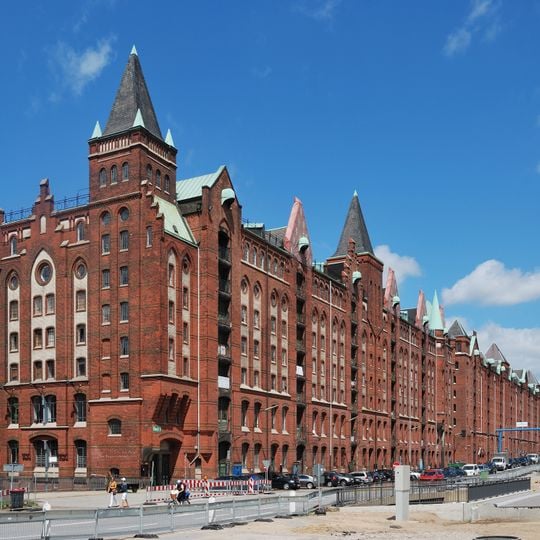
Speicherstadt and Kontorhaus District with Chilehaus, Maritime warehouse complex in Hamburg, Germany
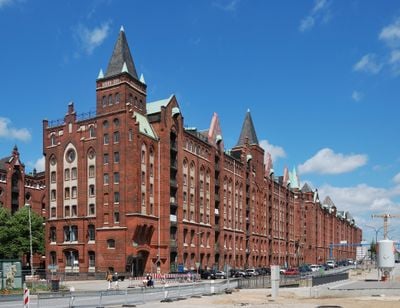
Speicherstadt and the Kontorhaus District with Chilehaus form a UNESCO World Heritage Site in Hamburg-Mitte. The Speicherstadt consists of 15 large red-brick warehouse blocks in Neo-Gothic style, with copper roofs, built on about 3.5 million timber piles. The Chilehaus, designed by Fritz Höger and completed in 1924, is a ten-storey office building clad in 4.8 million clinker bricks, with a sharp eastern corner resembling a ship's bow.
Speicherstadt was built from 1885 onward, after existing neighborhoods were cleared to make way for a connected warehouse complex raised on timber piles above the water. The Chilehaus was commissioned in the 1920s by a Hamburg merchant who had made his fortune in the saltpeter trade with Chile.
The Chilehaus is an office building from the 1920s whose front corner tapers to a sharp point, much like the bow of a ship. Walking past it, visitors can see how the curved facade draws the eye along the entire length of the block.
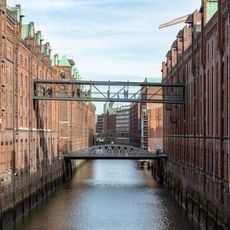
The core zone covers 26.08 hectares, with the Speicherstadt's 15 warehouse blocks and six ancillary buildings linked by a network of canals called Fleeten. The Kontorhaus District, five hectares with six office complexes, lies next to it. The warehouses stand on about 3.5 million timber piles driven into the soft ground of the Elbe lowland.
The warehouses stand on roughly 3.5 million wooden piles driven into the soft ground of the Elbe lowlands. The Speicherstadt was built between 1883 and 1927 on narrow Elbe islands, and about half of the complex was destroyed in the Second World War, with rebuilding running from 1949 to 1967.
The community of curious travelers
AroundUs brings together thousands of curated places, local tips, and hidden gems, enriched daily by 92,727 contributors worldwide.