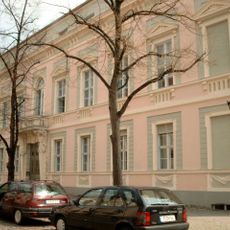
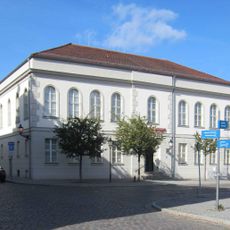
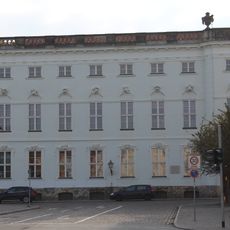
Marstall Potsdam, Royal stables architectural monument in Potsdam, Germany.
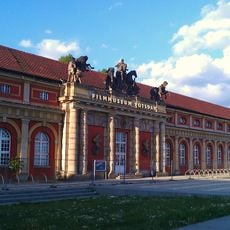
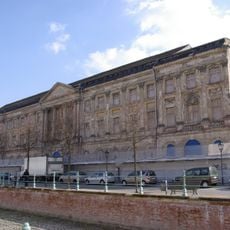
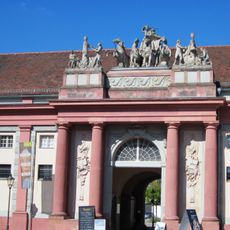
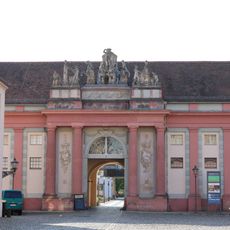
Marstall Potsdam is a long, single-storey Baroque building with a low half-storey above, on Breite Straße. Evenly spaced round-arched arcades reaching the ground run between Tuscan pilasters beneath a triglyph frieze, and two sandstone risalits with half-columns and attics carry horse-tamer sculpture groups by Friedrich Christian Glume. It is the oldest surviving building in the city centre.
Johann Arnold Nering built the orangery in 1685 for the Great Elector Frederick William, with 13 bays and a heated northern passage for winter. In 1714 Frederick William I turned it into a stable for the royal riding horses, moving the orange trees to a glasshouse in the Marlygarten. Frederick the Great had Knobelsdorff and Andreas Krüger rebuild it in 1746, extending the arcades to 33 bays and adding sandstone risalits with horse-tamer sculptures by Friedrich Christian Glume. After 1918 it became a garrison museum in 1922.
The two sandstone reliefs on the portals show horse tamers, a reference to the building's use as a royal riding stable from 1714. Since 1981 the former stable has housed the Potsdam Film Museum, and a restaurant has occupied part of it since 2003.
The Marstall stands on Breite Straße, its long sandstone facade facing the street; the rear side was altered in 1895. Since 2003 a restaurant has occupied part of the building, and the Filmmuseum Potsdam has been housed here since 1981, so interior access follows the museum's opening arrangements. The building was last renovated in 2014.
The horse-tamer and rider sculptures on the portal attics were carved by Friedrich Christian Glume, and they point back to the building's use as a royal riding stable. The long facade was extended westward to 33 bays in 1746, and a second sandstone risalit was added to break up the front.
The community of curious travelers
AroundUs brings together thousands of curated places, local tips, and hidden gems, enriched daily by 93,340 contributors worldwide.