Eschweiler Wald, Commercial and recreational forest in Eschweiler, Germany
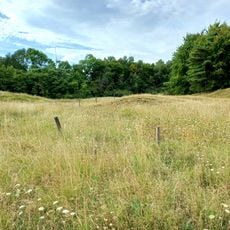
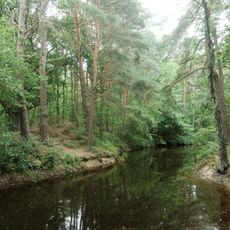
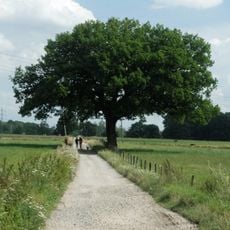
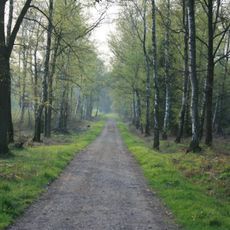
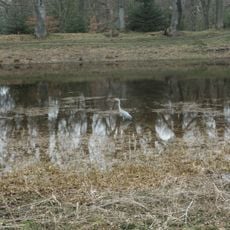
Eschweiler Wald is a forest in North Rhine-Westphalia that spans a large area with numerous paths connecting natural woodland and managed forestry zones. The woodland is crisscrossed with marked trails that link different sections throughout the terrain.
The present-day Stadtwald probably grew out of earlier Frankish holdings; municipal forest arose at the end of the 18th century from divisions of the princely woodland. The oldest forestry plan of 1854 listed 481 hectares, against about 350 today. Emissions from the Birkengang zinc works made roughly 40% of the woodland unusable for forestry, and after the Second World War the area had shrunk to 249 hectares before 70 hectares were added in 1953 and 24 more in the south in 1966.
The forest's name recalls the legendary dwarf people, the Killewittchen, after whom the 1947 Waldschänke inn in the southeast is named. Nearby stood an early 20th-century half-timbered house used as the office of the Hastenrath limestone quarries of the Eschweiler Bergwerksverein. The Eschweiler Geschichtsverein laid out a mining pit as it looked 600 years ago on 13 December 1994.
Two roads cross exactly in the middle of the forest, dividing it into four roughly equal quarters, so the crossroads works as a starting point. Four designated car parks and seven shelters serve walkers. Bus line 48 of the ASEAG stops at Eschweiler Stadtwald, connecting to Eschweiler-Mitte and Stolberg.
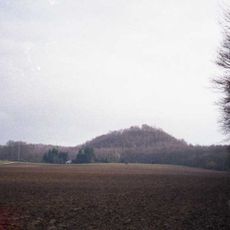
The Schwarzer Berg is an artificial mound about 50 m high, not a natural summit; a shelter once stood on top but was abandoned after repeated vandalism. At its foot lay the Centrum colliery, closed in 1891, whose many shafts still dot the forest. Station 1 of the geological trail is on the hill.
The community of curious travelers
AroundUs brings together thousands of curated places, local tips, and hidden gems, enriched daily by 93,897 contributors worldwide.