Burg Eschweiler, Medieval castle in Eschweiler, Germany.
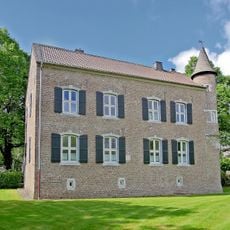
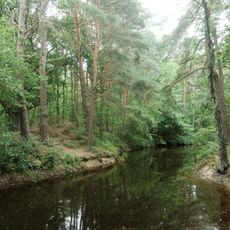
Burg Eschweiler is a medieval fortification located along the Inde River and defined by its stone walls and series of interior chambers. The complex displays typical defensive architecture with reinforced perimeter walls and multiple structures arranged within the fortified perimeter.
A building on the site served as the seat of a Schultheiß appointed by the Cologne Cathedral chapter; Wilhelm von Eschweiler is documented in 1145. Historians date the first castle to the 13th or 14th century. In 1642, during the Thirty Years' War, troops from Hesse, Weimar and France captured Eschweiler and the castle. Around 1800 much of the complex was demolished due to dilapidation, and in 1967 the remaining buildings gave way to a new St.-Antonius-Hospital.
The name Hompeschstrasse in Eschweiler-Mitte, formerly Hompeschgärten, commemorates the von Hompesch family that owned the castle for almost 180 years from 1654. A local legend tells of a ghost that haunted the castle and led a brave nobleman to a treasure hidden by three sisters; the new owner used the gold to help the poor.
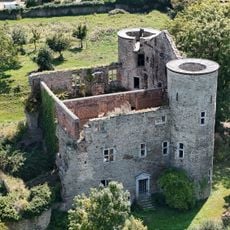
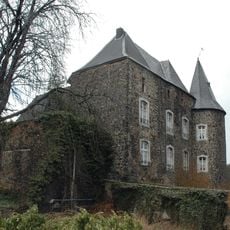
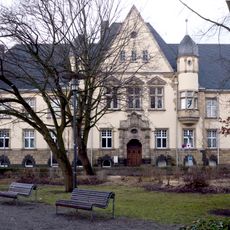
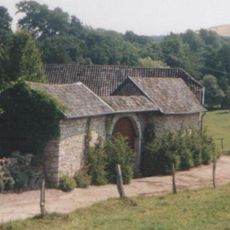
Only three round towers and a stretch of the perimeter wall survive, standing among the modern buildings of the St.-Antonius-Hospital on Dechant-Deckers-Straße in Eschweiler's town centre. The remains have been listed as a monument since 1992. Look for the towers within the hospital grounds rather than expecting a separate castle site.
The castle's moat was fed by a side arm of the Inde, not the river itself. The ring wall measured 197 by 93 metres and had six round towers with walls two metres thick; the square manor house was 21 by 21 metres. Around 1800 most of the complex was demolished as dilapidated, and the old dungeon was found beneath the south-east tower.
The community of curious travelers
AroundUs brings together thousands of curated places, local tips, and hidden gems, enriched daily by 94,514 contributors worldwide.