Burg Kinzweiler, Medieval castle in Eschweiler, Germany
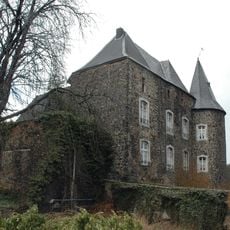
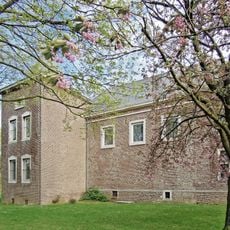
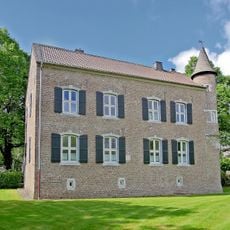
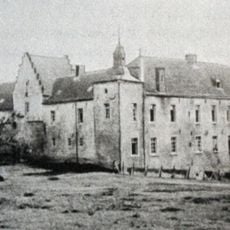
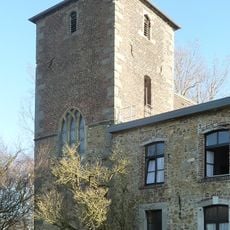
Burg Kinzweiler is a three-winged brick manor house surrounded on three sides by a moat, with a baroque cour d'honneur reached by a two-flight staircase. The south wing is shorter than the north, and the oldest parts are a partly rubble-stone cellar and Gothic cross-mullioned windows on the courtyard side. The segmental-arched windows and hipped roof date from the mid-18th century.
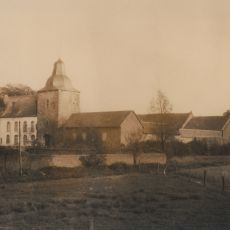
The von Palant family acquired the Kinzweiler estate with its two mottes in 1420 and built the present castle under Dietrich von Palant at the start of the 16th century. It stayed with the family until 1639, passed to Count Philipp Dietrich von Waldeck, and was bought in 1707 by Duke Ernst Friedrich I of Saxe-Hildburghausen. In 1747 Elector Karl Theodor of the Palatinate acquired it and had it rebuilt in Baroque style around the mid-18th century, incorporating Gothic fabric. The counts of Hatzfeld bought it in 1782 and sold it in 1845 to the Arenberg family; later owners included the Eschweiler Bergwerks-Verein (1928) and Rheinbraun's predecessor (1956), which demolished the two outer baileys in 1970.
The name Kinzweiler comes from the knightly family of the same name who held the estate before 1420. The lords of Palant acquired the property that year and kept it until 1639. A legend recorded around 1900 by the Düren collector Heinrich Hoffmann tells of a werewolf-like creature that sat on the chests of the farmhands sleeping in the barn, leaving them unable to cry out.
The Herrenhaus stands on the east side of Wardener Straße, opposite the junction with Kirchstraße in Eschweiler-Kinzweiler. It is private housing, so visitors can only view the brick building and its surrounding Gräfte from the public street; there is no interior access.
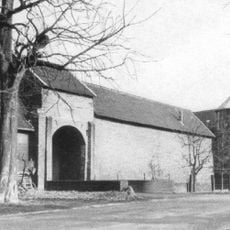
The two long rectangular outer baileys, demolished in 1970, once housed stables, barns, a smithy, a wheelwright's shop, a brewery and, until 1884, an oil mill. A legend recorded around 1900 by the Düren collector Heinrich Hoffmann tells of a werewolf-like creature that sat on the chests of servants sleeping in the barn and nearly suffocated them.
The community of curious travelers
AroundUs brings together thousands of curated places, local tips, and hidden gems, enriched daily by 94,487 contributors worldwide.