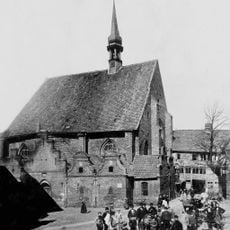
Gewerkschaftshaus Kiel, Trade union building in Damperhof district, Kiel, Germany.
The Gewerkschaftshaus Kiel is a brick building with sandstone details designed by architect Carl Voss at Legienstraße 22-24 in central Kiel. Its interior features large halls and meeting rooms with high ceilings built to accommodate gatherings of workers and unions.
Workers funded the building by buying shares, and the foundation stone was laid on October 4, 1904, at Fährstraße, renamed Legienstraße in 1923. Carl Legien inaugurated it on July 26, 1907. In 1926 Arnold Bruhn added a Muhliusstraße wing with brick-expressionist facade figures by Franz Schweighofer. Nazis seized it on May 2, 1933; unions repurchased it in 1947.
The street outside is named Legienstraße after Carl Legien, who handed over the building in 1907; it had been Fährstraße, and the name Legienstraße was used from 1923 to 1933 and again since 1947. Inside, the restaurant Legienhof continues the house's original function as a place to eat and meet. On International Women's Day, 8 March 2017, Tina Schwichtenberg's artwork "Mein roter Frauensalon" was hung in the building.
The building at Legienstraße 22–24 is the working seat of the DGB, several individual unions and the education body Arbeit und Leben Schleswig-Holstein, and the Kiel SPD also uses it for meetings and events. It is not a museum, so there are no visiting hours or tours; the Legienhof restaurant on the premises is the part most open to the public. Read the memorial plaques on the facade from the street.
Albert Einstein delivered a lecture here on September 15, 1920, about his theory of relativity after the local university declined to host him. This event shows how the building welcomed important intellectual debates that were initially controversial in academic circles.
The community of curious travelers
AroundUs brings together thousands of curated places, local tips, and hidden gems, enriched daily by 92,686 contributors worldwide.