Hajener Hungerstein, Natural monument in Emmerthal, Germany
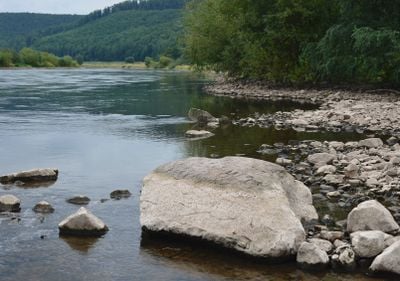
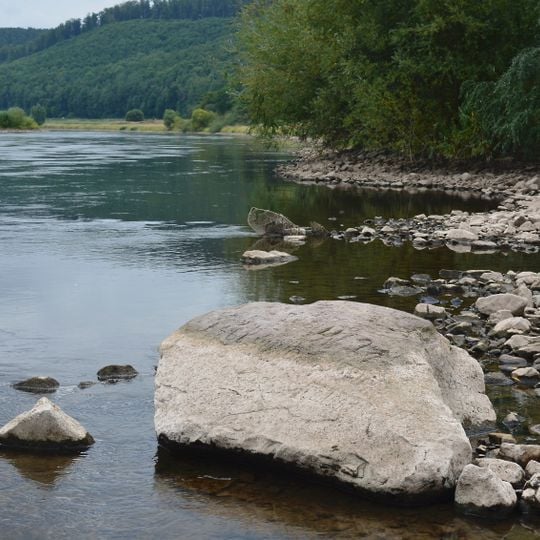
The Hajener Hungerstein is a red sandstone erratic measuring 1.5 by 1.8 metres and 0.8 metres high, lying at the foot of a groyne on the western bank of the Weser at kilometre 119.7, opposite Hajen. Its broad, roughly flat top slopes to the right and carries faint carved markings, including the word "Hungerstein" and dates such as 1947, 1959, 1975, 1984 and 1991. A smaller stone sits in the water to its left, and another elongated stone lies behind and to the right.
The stone bears the inscription "Hungerstein" and carved years such as 1947, 1959, 1975, 1984 and 1991, some with the initials or names of those who cut them. It was visible again during the droughts of 2018 and 2022. In 1997 citizens applied to protect it for its local-history value, and in 1998 the Hameln-Pyrmont district declared it a natural monument.
The stone carries engravings of years and initials left by local people, showing how droughts shaped life in the region. These markings connect the community to a shared history of water scarcity and its effects on their lives.
The stone sits on the western bank of the Weser at kilometer 119.7 and becomes visible when water levels drop below 1.18 meters. Visitors should check current water conditions before visiting, as the stone is only accessible during specific water levels.
In August 1996 villagers found the stone gone, after dredging had been carried out nearby; the waterways office said it had not touched the stone. A resident swimming in the Weser struck a boulder and called in fire-service divers. Days later a floating dredger recovered the block, identified as the missing Hungerstein, and surveyors from the cadastral office set it back in its original spot before over 500 onlookers in a fair-like mood.
The community of curious travelers
AroundUs brings together thousands of curated places, local tips, and hidden gems, enriched daily by 93,778 contributors worldwide.