Dorfkirche Kirch Rosin, Gothic brick church in Mühl Rosin, Germany
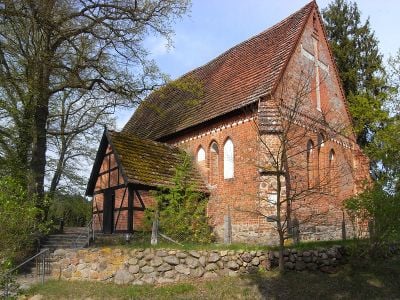
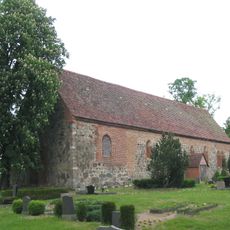
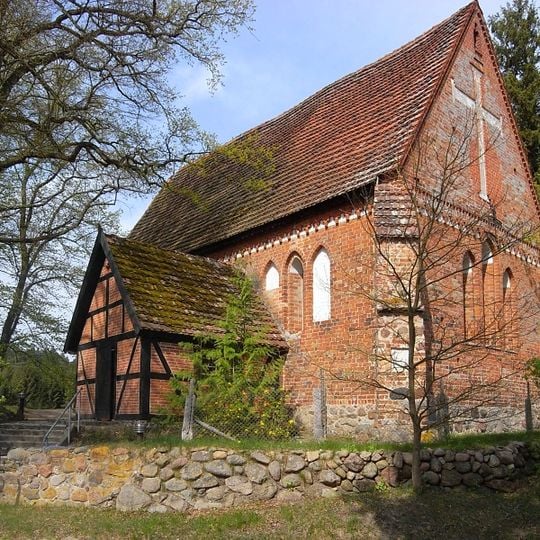
Dorfkirche Kirch Rosin is a single-nave Brick Gothic church with a rectangular plan, built around 1270–80. Its red brick walls have tall pointed-arch windows outlined in white, a large cross in lighter brick on the upper right, and a surrounding dentil frieze above a pointed-arch frieze. A lower timber-framed section with mossy tiles stands to the left.
The brick church dates from around 1270/80. Rosin was first documented in 1228, and in 1229 the princes of Rostock granted the village to the Cistercian monastery Michaelstein, which held it until 1433, when it passed to Doberan Abbey. The wooden tower was built in 1690, though a wooden bell frame existed by 1450.
The wall paintings date from 1620 to 1630 and show four Old Testament prophets: Moses, Nathan, Isaiah and Jeremiah, among scrollwork, tendrils and many inscriptions. They were uncovered during the 1987–1989 restoration. The scheme is linked to the period of pastor and former schoolteacher Martin Bambam, when Duke Johann Albrecht of Güstrow was patron of the church.
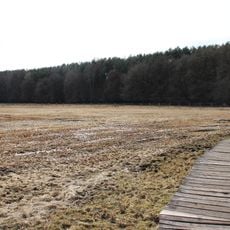
The church stands behind a low stone wall and wire fence at the edge of the Güstrower Feldmark; the brick nave and the timber-framed annex with its dark door face the approach. The organ now sits in a pointed-arch niche on the west side, and the 1880 bell from Cammin hangs in the tower. The small third bell is kept in the Lohmen parsonage, not here.
The organ is a rare cabinet organ by Heinrich Rasche from 1839, with six registers on one manual and no pedal. In 1980 Wolfgang Nußbücker repaired it and moved it to the Catholic church in Neubrandenburg; it returned in 1989 and now stands in a pointed-arch niche on the west side.
The community of curious travelers
AroundUs brings together thousands of curated places, local tips, and hidden gems, enriched daily by 92,709 contributors worldwide.