Wind hole in the Mühlenberg, cave entrance in Ründeroth, Germany
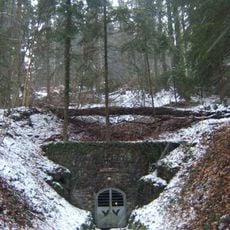
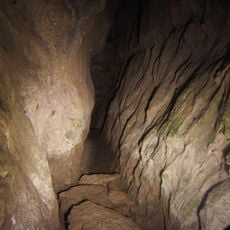
The Windloch im Mühlenberg is a labyrinthine karst cave system in the Ründeroth district of Engelskirchen, with a documented length of 8,453 m. Its entrance, closed to the public, lies northeast of the Aggertalhöhle. Explorers first found passages about one kilometre long and hall-like sections 40 m wide. The cave contains crystals, fossils and rare gypsum formations.
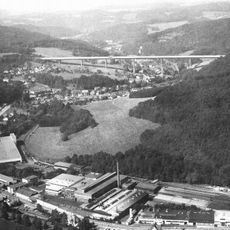
The Windloch im Mühlenberg lies in Middle Devonian Hobräck limestone, a reef platform up to 100 m thick, and is at least 35 million years old. Researchers suspected passages in the Mühlenberg for decades and searched for an entrance from 1988, guided by the Walbach stream, which sinks into swallow holes and resurges on the far side of the hill in under four hours. In 2009 warm air rising from fissures exposed during roadworks led mayor Gero Karthaus to contact Stefan Voigt, whose team found the entrance; the Arbeitskreis Kluterthöhle made the first descent on 23 March 2019.
The site holds scientific value for researchers who conduct geological studies and document the underground structures of the Mühlenberg cave system.
The cave is not open to visitors and cannot be entered. You can visit the nearby Aggertalhöhle cave instead, which offers guided tours with information about the region's cave systems.
The cave holds what may be Europe's largest iron flowers, gypsum formations roughly 2 cm across, along with crystals and fossils. A dried-out frog found deep inside has never been explained, and no cave-fauna studies have been published. The Walbach stream sinks into swallow holes on the mountain and resurfaces on the far side in under four hours.
The community of curious travelers
AroundUs brings together thousands of curated places, local tips, and hidden gems, enriched daily by 94,397 contributors worldwide.