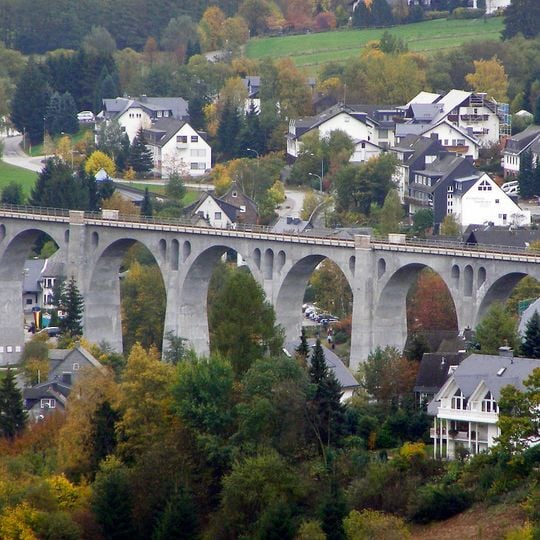
Willingen Viaduct, Railway bridge in Willingen, Germany.
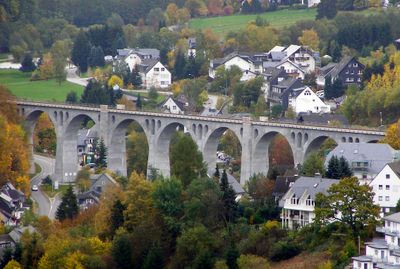
The Willingen Viaduct, officially the Itter Bridge, is a single-track railway bridge on the Upland line, 294 metres long and 31 metres high. It crosses the Itter valley and the B 251 road southwest of the Orenberg on the southeastern edge of Willingen. Its eleven arches, each with a 25-metre span, rest on ten piers and two abutments and are built of natural stone and poured concrete.
The Royal Prussian State Railways built the structure between 1914 and 1917 as part of the Wega-Brilon Wald railway line. The project was created when this mountain region was being connected to the national rail network.
The structure is a protected cultural monument and shows how railway engineers thought in the early 20th century. The stone arches and piers are typical features of that era and still shape the landscape today.
The best view of the viaduct comes from below in the valley, where you can see the arches and piers at full height. The bridge is best viewed in daylight and can be reached from several paths in the area.
The bridge's hollow piers, filled with poured concrete of varying quality, were drilled with 80 mm boreholes down to the foundations in 1999 and injected with cement suspension to restore stability. The weathered stone outer shell was cleaned at 2000 bar and rebuilt with sprayed concrete.
The community of curious travelers
AroundUs brings together thousands of curated places, local tips, and hidden gems, enriched daily by 93,394 contributors worldwide.