Gemeindehaus der Matthäusgemeinde, A building in Berlin-Steglitz
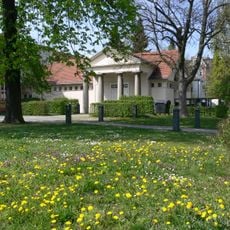
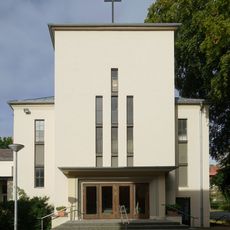
The Gemeindehaus der Matthäusgemeinde is a community center in Berlin-Steglitz built between 1928 and 1930. The building features a simple brick facade in reddish-brown tones, a flat profile with a sloping roof, and a U-shaped layout that creates a quiet courtyard shielded from the busy street.
The building was designed by architects Otto Rudolf Salvisberg and Rudolf Reichel and is Salvisberg's only independent community center. Construction ran from September 1928 to November 1930 and cost over half a million reichsmarks, funded through loans taken by the expanding congregation.
The entrance hall was long used for events and was named "Bethel-Halle" on 6 June 1967, after the centenary of the von Bodelschwinghschen Stiftungen Bethel, in the presence of Friedrich von Bodelschwingh and Bishop Kurt Scharf. For the 1978 renovation, church elder and art teacher Heinz Krieg made a triptych with children of the congregation: three canvases of 1.8 by 2 metres showing scenes from the Old Testament, the life of Jesus and the Acts of the Apostles.
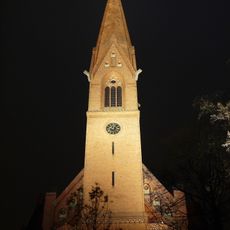
The building stands at Schloßstraße 44, directly in front of the Matthäuskirche, not at the end of the street. The main entrance opens through a wide, four-pillared passage that frames the view of the church; the other entrances are hidden from this passage. A step-free entrance to the Küsterei (parish office) was added only in 2013.
The only exterior ornament on the building is a ceramic relief to the right of the main entrance, made by the Steglitz sculptor August Rhades (1886–1979) and given by the church district Kölln-Land I. It shows the parable of the wise and foolish virgins from Matthew 25, with the wise ones turning their eyes toward the Matthäuskirche, and it quotes verse 13: "Wachet, denn ihr wisset weder Tag noch Stunde."
The community of curious travelers
AroundUs brings together thousands of curated places, local tips, and hidden gems, enriched daily by 94,303 contributors worldwide.