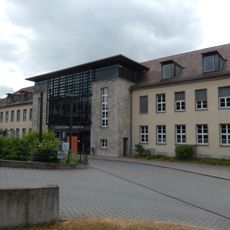
Karlsmühle, Historic mill structure in Weimar, Germany
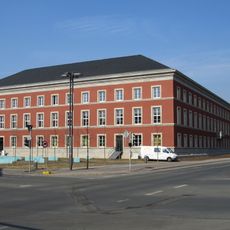
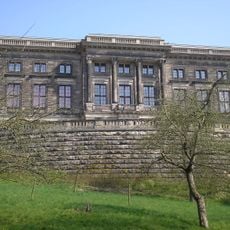
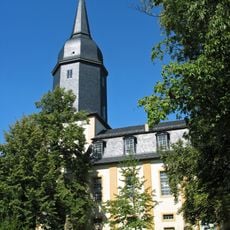
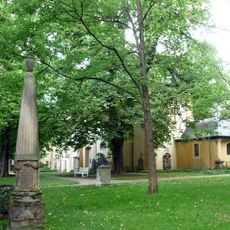
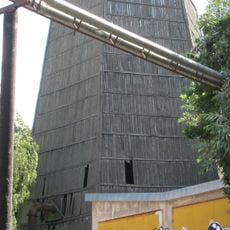
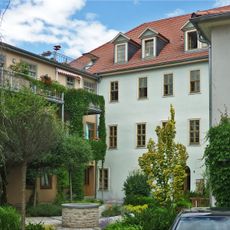
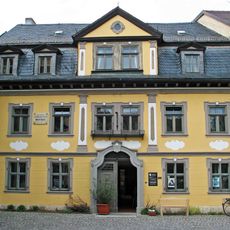
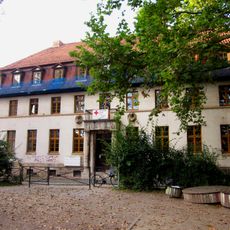
Karlsmühle is a historic mill structure on the Ilm River bank in Weimar, located beneath the Peace Bridge and Jena Street. The partly unused building is overgrown with vegetation and displays the characteristic architecture of a traditional water mill.
First recorded around 1375 as "nydirstin mul" and called Niedermühle until 1845, the mill passed to the town of Weimar in 1577. Grain was ground here, with an oil mill mentioned in 1705 and a barley mill in 1741; water came from the Ilm and the Asbach via the mill race. Steam power arrived in 1885, making it the largest and most modern mill on the Ilm. A 5 February 1945 air raid hit it; the middle section was rebuilt and the turbine house chimney still stands.
The name Niedermühle, used until 1845, referred to its position as the lower mill on the Ilm. The mill was a grain mill, mentioned as an oil mill in 1705 and with a barley gang in 1741. A maid of the Niedermühle, Johanna Catharina Höhn, was executed with the sword in 1783 for child murder.
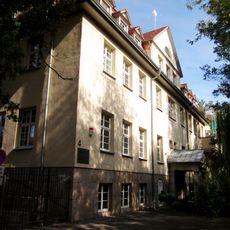
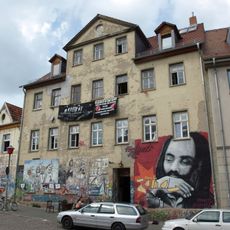
The mill stands at Brühl 28, 28a in the Jakobsvorstadt, and the covered mill canal between the buildings is visible only from the Ilm at its mouth. The warehouse buildings are threatened by decay, and restoration work has been under way since 2022, so expect scaffolding and limited access. The weir at the Kegelbrücke is separately protected.
The Ilm weir at the Kegelbrücke is the last surviving trace of the Burgmühle, which burned down in 1882. The Carlsmühle's own weir is also listed as a monument. In 1783 the mill's maid, Johanna Catharina Höhn, was executed with the sword for infanticide.
The community of curious travelers
AroundUs brings together thousands of curated places, local tips, and hidden gems, enriched daily by 92,813 contributors worldwide.