Drei-Tröge-Brunnen, Historic fountain in Heidelberg, Germany
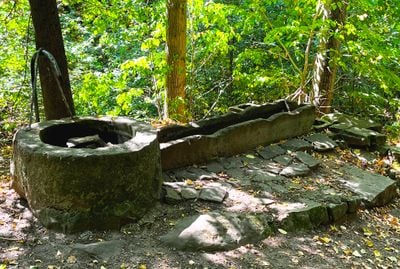
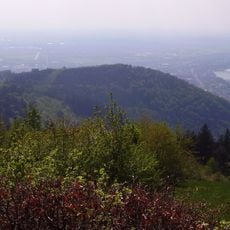
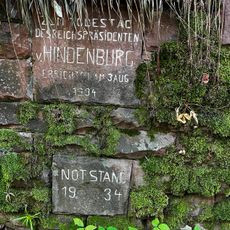
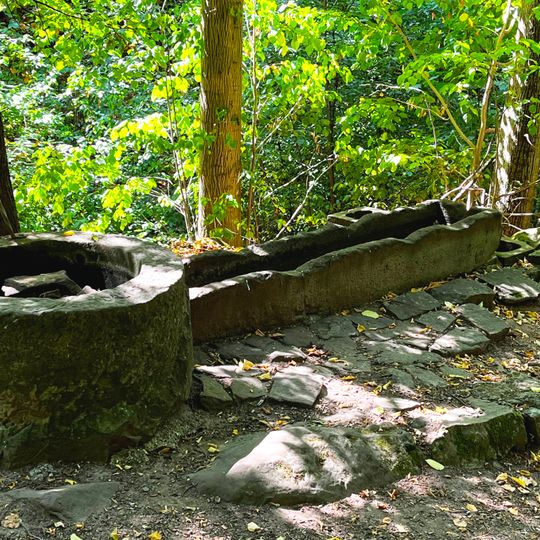
The Drei-Tröge-Brunnen is a fountain on the west slope of the Gaisberg near Heidelberg, made of three separate red sandstone troughs fed by a spring captured in a 19th-century well tunnel. The spring lies uphill at 210 m above sea level between the Bierhelder Steige and the Unterer Dachsbuckelweg. The troughs stand about 100 m from the Drei-Tröge-Hütte, a rest shelter in the Kleiner Odenwald.
The three sandstone troughs date from 1887, but the spring was already captured in the 19th century by a well tunnel. A lithograph of 1830 by the Heidelberg painter Ernst Fries shows the original spring outlet with three troughs, kept today in the Kurpfälzisches Museum. The fountain was extensively restored in 1984.
The three troughs let several animals drink at once during the cattle drives to the Kühruhe pasture, documented in 1744. The spring served as a rest stop on the steep Bierhelder Steige, part of a route from the Rhine plain to the Odenwald. A lithograph of 1830 by the Heidelberg painter Ernst Fries records the original spring outlet with its three troughs; the print is held by the Kurpfälzisches Museum.
The fountain sits along a hiking path and is accessible throughout the year, though the route involves climbing a hillside. Sturdy walking shoes and time for a moderate climb are recommended.
The three separate troughs allowed multiple animals to drink at the same time rather than one after another. This practical design was essential during livestock drives when large herds needed watering quickly.
The community of curious travelers
AroundUs brings together thousands of curated places, local tips, and hidden gems, enriched daily by 92,744 contributors worldwide.