Kolonialstein, Memorial stone in Heidelberg, Germany
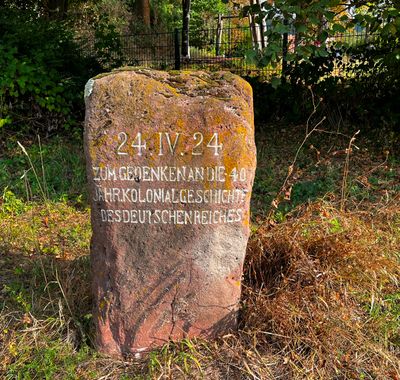
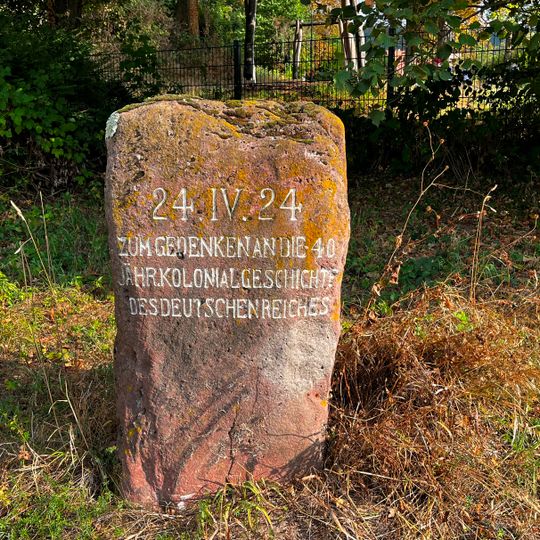
The Kolonialstein is a sandstone memorial stone measuring 100 × 60 × 30 cm, unveiled in 1924 at the northern edge of the Bierhelderhof clearing in Heidelberg's city forest. It stands at the acute angle where the Saupfercheckweg meets the Bierhelderhofweg, about 200 m from the Ehrenfriedhof, next to the Kolonialbrunnen fountain.
The Kolonialstein was unveiled on 24 April 1924, the German Colonial Remembrance Day, in Heidelberg's city forest. Former officers who had served with the Schutztruppe in German South West Africa in 1904, geographer Alfred Hettner and former governor Theodor Seitz pushed for the monument. Carved from local Neckar valley sandstone, it recalls the 24 April 1884 founding of Germany's first colony, German South West Africa, today Namibia.
The inscription reads "24.IV.24 Zum Gedenken an die 40jähr. Kolonialgeschichte des Deutschen Reiches", tying the stone to 24 April 1884, when Bismarck placed Lüderitzbucht under Reich protection. The site is still called Kolonialstein, and since 1924 it has stood beside the Kolonialbrunnen as a paired ensemble in the city forest.
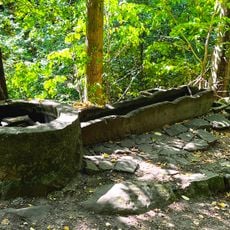
The memorial and the adjacent Kolonialbrunnen stand at the northern edge of the Bierhelderhof clearing, about 200 m from the Ehrenfriedhof, at the fork where the Saupfercheckweg meets the Bierhelderhofweg. VRN bus lines 39 and 39A serve the site. A steep old path, the Soldatenweg, still partly survives at the Drei-Tröge-Brunnen.
The stone was funded by private donations and the Deutsche Kolonialgesellschaft, and among those behind it were former Heidelberg officers who had served with the Schutztruppe in Deutsch-Südwestafrika in 1904, alongside geographer Alfred Hettner and former governor Theodor Seitz. Klara Wagemann, chair of the society's Heidelberg women's league, is also named in connection with the project.
The community of curious travelers
AroundUs brings together thousands of curated places, local tips, and hidden gems, enriched daily by 92,871 contributors worldwide.