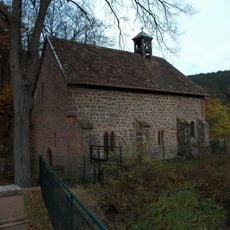
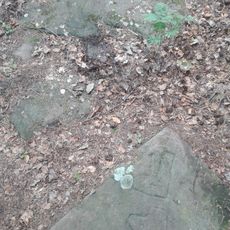
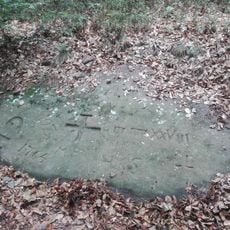
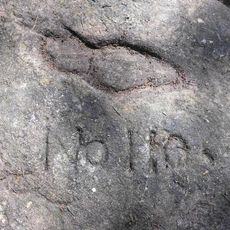
Obere Mühle, Historic watermill in Deidesheim, Germany.
Obere Mühle was a watermill in the lower Silbertal, about 100 metres above where the Benjental joins the Mußbach valley, near the remains of the Gienanth iron forge. The mill building was demolished in 1958 because it had become dilapidated, and the valley section is now fully forested; only the site remains.
A grinding mill was first documented in 1711. From 1799 it operated as a sawmill, and in 1858 the Wappenschmied Georg Koch from Annweiler bought it and converted it into a Wappenschmiede. The community of Mußbach purchased the property in 1892 and ran the inn "Pfälzer Waldhaus Wappenschmiede" there from 1904; the building was rented privately from 1919 and demolished in 1958 as dilapidated. The valley section is fully forested again today.
The name "Eselsmühle" comes from the donkeys that carried grain and flour over the Stabenberg's south-west and west slopes to Deidesheim after the 1715 customs border between the Hochstift Speyer and the Kurpfalz. The local Eselsweg themed trail recalls that route. The mill was demolished in 1958 and the valley section is fully forested again.
You can explore the former mill site while hiking along the marked Mußbach trail, which connects several historical mill locations in the region. The path is relatively easy to follow and offers good signage throughout the valley.
The mill building was demolished in 1958 because it had become dilapidated, and the valley section is now fully wooded again; nothing of the structure remains above ground. The site lies about 100 metres above where the Benjental joins the Mußbach valley, near the remains of the Gienanth iron forge.
The community of curious travelers
AroundUs brings together thousands of curated places, local tips, and hidden gems, enriched daily by 94,227 contributors worldwide.