Ringwall Koblenzer Dommelberg, Celtic fortification in Koblenz, Germany
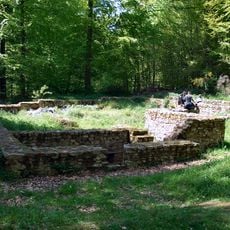
Ringwall Dommelberg is a Celtic fortification in the forest near Koblenz with multiple oval wall sections surrounding a large area. Deep trenches run alongside the walls and together form a dense defensive system.
The rampart was first built in the 11th century BCE during the Urnfield culture, when the lower earthwork was faced with a stone-packed wall. A second phase in the 6th–5th century BCE, during the Hunsrück-Eifel culture, added a dry-stone wall about 3 m high on the collapsed rampart. Excavations by the Landesmuseum Bonn in 1936 identified these phases. The site was violently destroyed by fire around the start of the 5th century BCE and not rebuilt.
The site's purpose is debated: historian Hans Bellinghausen argued in 1971 that the walls served as a refuge fort (Fliehburg) where nearby people sheltered with their belongings and livestock in times of war, and he did not rule out a ritual function. Prehistorian Hans-Helmut Wegner instead held in 1999 that the site was permanently occupied at times, especially from the 5th century BCE.
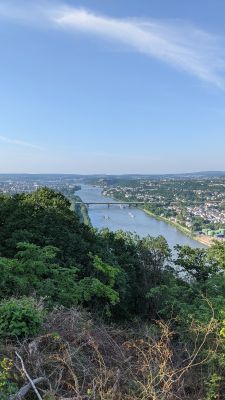
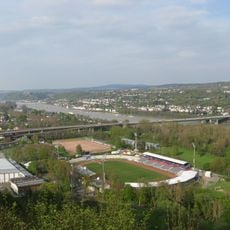
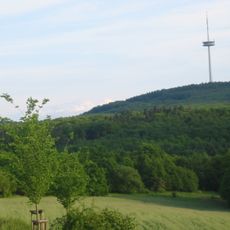
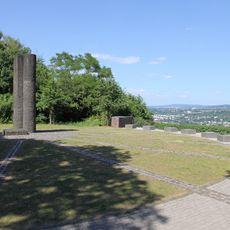
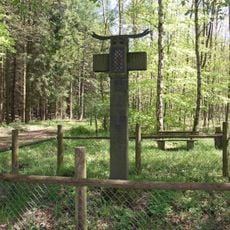
The ramparts lie in the Koblenzer Stadtwald on the Kühkopf, on two hilltops about 200 m high between the Königsbach and Siechhausbach valleys. No walls were found on the Rhine side, where steep slopes with scree stands in for defences. From the north summit viewpoint the view runs downstream over Koblenz and the Neuwieder Becken; a shelter with a wide panorama stands on the Weidgenhöhe.
The walls contain remains of wooden reinforcements that show the Celtic builders used advanced techniques. These wooden structures were carefully integrated into the earthen walls to help keep them stable.
The community of curious travelers
AroundUs brings together thousands of curated places, local tips, and hidden gems, enriched daily by 93,595 contributors worldwide.