Burg Hornburg, Medieval castle in Hornburg, Germany.
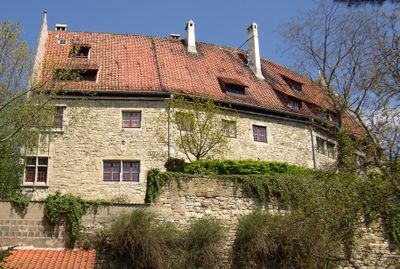
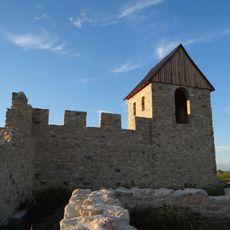
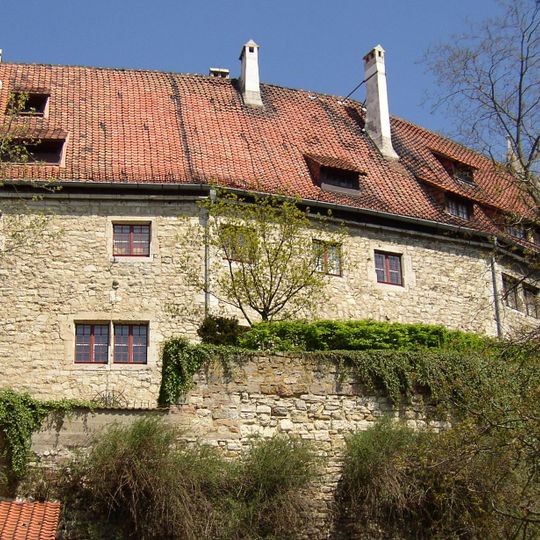
Burg Hornburg is a hilltop castle on a wedge-shaped rise above the town of Hornburg, with an oval core of about 40 by 100 metres enclosed by a ring wall. Its round bergfried measures eleven metres across with walls three metres thick, and three half-round flanking towers stand in the outer wards. From outside, the wall and the 1920s house modelled on the palas are visible.
A border castle of the Halberstadt bishopric, it was first recorded as Hornaburg in 994. It was destroyed in 1113 by Henry V, in 1179 by Henry the Lion, and in 1430 by the dukes of Brunswick-Lüneburg. Swedish general Königsmarck destroyed it a fifth time in 1645; it was then used as a quarry and not rebuilt.
The castle gave its name to the town that grew in its shelter from the early 14th century, and it remains Hornburg's landmark. Its outer wall and the 1920s house modelled on the Palas can be seen from outside; the interior is private.
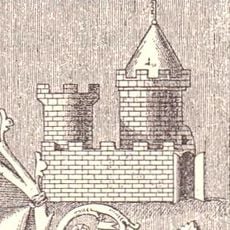
The castle is privately owned and cannot be visited inside; only the outer walls and the house modelled on the palais are visible from outside. A steep path connects the town centre with the castle hill. The 1927 reconstruction followed a Merian engraving of around 1650 and plans by architect Bodo Ebhardt.
Suitger von Morsleben, born at Hornburg around 1005, was elected Pope Clement II at the Synod of Sutri in December 1046, the first German pope. He had been Bishop of Bamberg since 1040, appointed by Henry III.
The community of curious travelers
AroundUs brings together thousands of curated places, local tips, and hidden gems, enriched daily by 92,774 contributors worldwide.