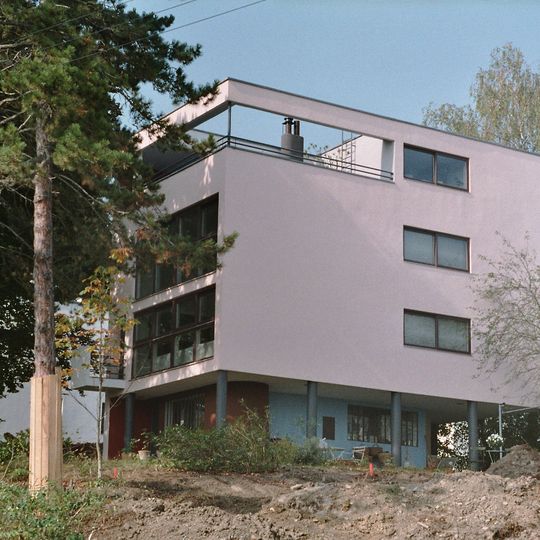
Citrohan House, Modernist single-family house in Stuttgart-Nord, Germany
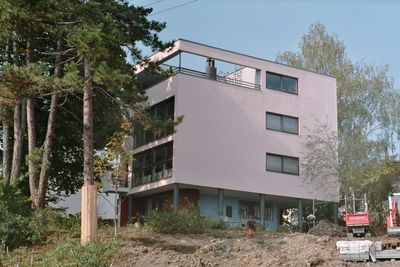
The Citrohan House is a single-family house built in 1927 for the Weißenhofsiedlung exhibition in Stuttgart. It has a rectangular, multi-storey form with a smooth pale pinkish-white facade, a flat roof with a recessed top level enclosed by a thin black metal railing, and a cylindrical chimney. The lowest level is recessed and supported by square concrete columns, with a dark reddish-brown wall and a glazed section.
Le Corbusier and Pierre Jeanneret created this housing prototype in 1927 as part of the Weissenhof Exhibition to demonstrate new residential concepts. The project became a turning point in the development of modern housing in the 20th century.
The house shows how people in the 1920s wanted to live differently. Open rooms and large windows were meant to simplify daily life and bring more light into the home.
The house stands in the Weißenhofsiedlung in Stuttgart-Nord, on a slope above the city centre, and is reached on foot from the nearby bus and tram stops. It is one of the terraced houses of the estate, so the entrance side faces the street while the garden front looks downhill.
The house was originally planned as a temporary pavilion for the exhibition but its success led to permanent preservation. Today it is part of a group of 12 buildings together protected by UNESCO as a heritage site.
The community of curious travelers
AroundUs brings together thousands of curated places, local tips, and hidden gems, enriched daily by 93,125 contributors worldwide.