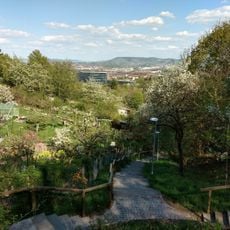
Stangenwald, Cultural heritage monument in Stuttgart, Germany.
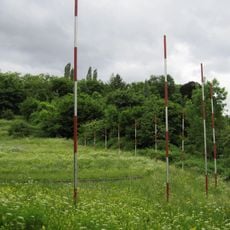
Stangenwald is a sculpture in Stuttgart composed of vertical elements that create a distinctive pattern across the urban landscape. The arrangement shapes how people move through and perceive this particular area of the city.
Hans Dieter Schaal designed the Stangenwald as one of the art stations built for the International Horticultural Exposition (IGA '93) in Stuttgart's Höhenpark Killesberg; it remained after the exhibition. A model was made in 1989 and shown in 1990 at the Galerie der Stadt Stuttgart and in 1992 at the Kunstverein Ulm. Schaal also created the Villa Moser station in the Leibfriedscher Garten.
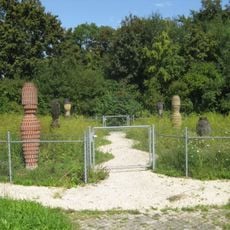
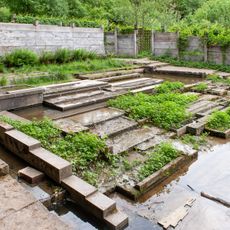
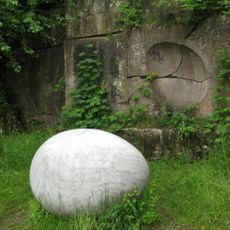
The name Stangenwald comes from forestry, where it describes dense stands of tall, branchless trees that look like poles. Hans Dieter Schaal's design plays on this: white concrete columns rise from a grid of stone slabs, topped by a white steel pergola. A station sign at the site asks whether the arrangement is a thought-provoking comment on the poor state of our forests.
The Stangenwald lies in the Höhenpark Killesberg, reachable by public transport; the park's paths are paved and level around the installation. The outer rectangle measures about 25 by 36 metres, with the column grid covering an inner area of roughly 18 by 22.5 metres. Benches and concrete chairs stand at the edges, and the site can be walked through from all sides.
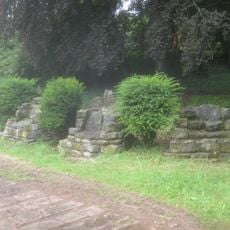
In the northeast corner six columns are missing: five lie on the ground as if toppled, their stumps still visible in the earth, and the pergola bars that crowned them were torn away. A small grid of two long and three short bars lies behind the hedge in front of the three concrete benches, as if flung over it when the columns fell.
The community of curious travelers
AroundUs brings together thousands of curated places, local tips, and hidden gems, enriched daily by 92,648 contributors worldwide.