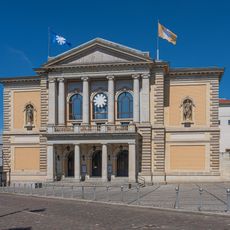
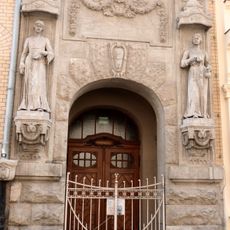
Lions building, Neoclassical university building in Halle, Germany.
The Lions Building is a neoclassical university structure in Halle featuring symmetrical facades, grand columns, and thoughtfully designed interior spaces. The main auditorium displays typical academic classicism with clear, dignified architecture throughout its layout.
Built from 1832 to 1834 as a new auditorium building, it replaced the former Franciscan monastery demolished in 1828; the design came from Schinkel's pupil Ernst Friedrich Zwirner with Wilhelm August Stapel and Wilhelm Heinrich Matthias. It was the first university new building completed in Germany in the 19th century, and its assembly hall was inaugurated on Reformation Day 1834. Planned as the central wing of a larger complex, it stayed a single cube because the side wings were dropped for cost reasons.
The building functions as a central venue for university events, academic ceremonies, and scholarly gatherings in the region. Students and visitors experience the tradition of university life reflected in how the spaces are used daily.
The building is located at Universitaetsplatz 11 in the city center and is accessible via several entrances. Visitors should note that some areas are open only during university events, and guided tours provide better access to the interior.
The cast-iron lions at the entrance stair were made by Johann Gottfried Schadow in 1816 for a monument in Bunzlau; Halle bought the casts in 1822 and placed them on the market fountain the next year. When that fountain was removed in 1868, the lions were moved to the university building's steps. Students first called it the Lions Building, and the name is now official.
The community of curious travelers
AroundUs brings together thousands of curated places, local tips, and hidden gems, enriched daily by 92,781 contributors worldwide.