Wasserwerk Schierstein, Waterworks in Schierstein, Wiesbaden, Germany.
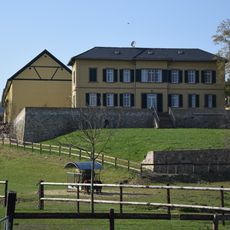
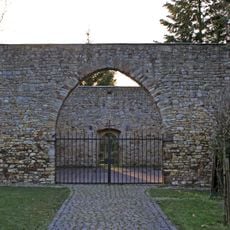
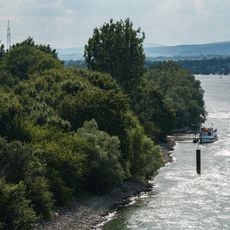
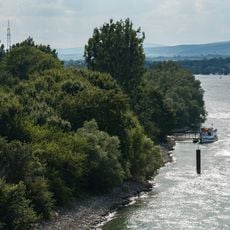
The Wasserwerk Schierstein stands on the Rhine between Wiesbaden-Schierstein and Niederwalluf. The brick engine and boiler house and the filter building from the 1904–1907 expansion, built in a Romanesque style, survive from the early plant; the chimney is gone. Two horizontal filter wells replaced 42 vertical wells in 2012, and the grounds hold sedimentation and infiltration basins.
Wiesbaden's thermal springs yielded no drinkable groundwater, so from 1899 to 1901 eight wells were sunk on the unpaved Schierstein bank, initially for service water. In 1901 the plant, built for 250 cubic metres per hour, became Germany's first waterworks with an ozone generator, and the city's typhus epidemic stopped abruptly. A brick Romanesque-style pumping station followed between 1904 and 1907.
The site is a stop on the Route der Industriekultur Rhein-Main Wiesbaden, which marks industrial monuments in the region. Its brick engine and boiler house and the filter building from the 1904–1907 expansion survive; the chimney does not. The grounds are a designated water protection area and host a white stork colony.
The facility grounds can be viewed from accessible areas, though access to active treatment zones may be restricted for safety reasons. Visitors should look for marked pathways and observation points that offer views of the operations without disrupting the work.
The grounds are a designated water protection zone and hold a white stork colony; the site is also a stop on the Route der Industriekultur Rhein-Main Wiesbaden. The 1960 river-water treatment plant next to the dike, with its sedimentation and infiltration basins, was taken out of service in 2017.
The community of curious travelers
AroundUs brings together thousands of curated places, local tips, and hidden gems, enriched daily by 93,852 contributors worldwide.