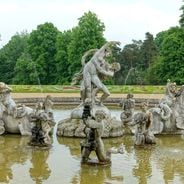
Pirene, Ancient fountain in Ancient Corinth, Greece
Pirene is an ancient spring complex where water flows from openings carved into the rock face and collects in an open basin surrounded by stone structures. The site displays multiple chambers built at different levels within the rock, designed to collect and distribute the water supply.
The first structures found at the spring date from the Archaic period, in the 8th and 7th centuries BC. In Greek times the fountain had six antechambers closed by a screen wall with Ionic half-columns, feeding three draw basins from six reservoirs cut into the marl; it was apparently little damaged when Corinth was destroyed in 146 BC. A generation after the Roman refoundation of 44 BC, a wall pierced by six arches was built in front of the Greek facade, turning the antechambers into new basins. Bert Hodge Hill distinguished about twelve architectural phases, seven of them Roman.
Pausanias records that Pirene was a woman who turned into a spring from tears shed for her son Cenchrias, killed unintentionally by Artemis; her other son Leches gave his name to Corinth's port of Lechaion. Poets came to drink here seeking inspiration, and the spring was sacred to the Muses. Pausanias also saw near it a sanctuary of Apollo with a painting of Odysseus attacking the suitors.
The site sits within the Archaeological Site of Ancient Corinth and can be explored as part of a visit to this wider area. Wear sturdy shoes, as the ground is uneven and rocky in places throughout the complex.
Pausanias reports that Corinthian bronze, when red-hot, was tempered in the water of Peirene, which gave the metal its finish. He also notes that near the spring stood an image and a sacred enclosure of Apollo, inside which hung a painting of Odysseus attacking the suitors.
The community of curious travelers
AroundUs brings together thousands of curated places, local tips, and hidden gems, enriched daily by 92,819 contributors worldwide.