Castle of Mytilene, Medieval fortress at the northern harbor of Mytilene, Greece
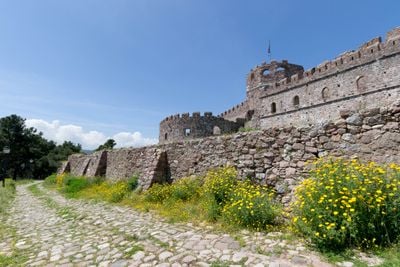
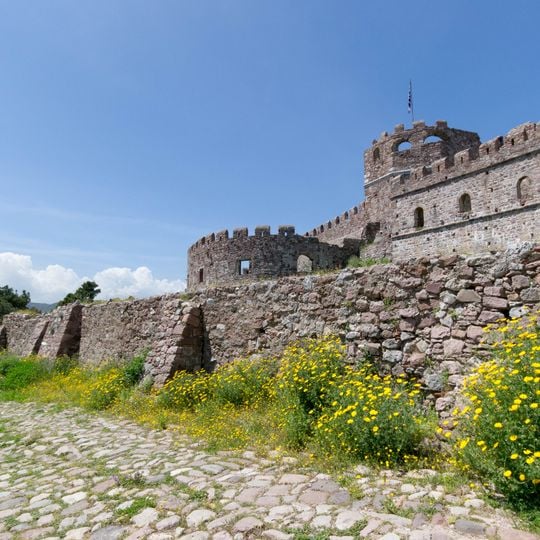
The Castle of Mytilene is a fortress on a hill between the northern and southern ports, covering 60 acres. Its rough stone walls in brown, grey and pinkish tones step up to a crenellated section with a round arched opening and narrow vertical windows. A curved battlemented tower rises behind the lower wall, and a flagpole stands on the highest tower. The site is divided into Upper, Middle and Lower Castle.
The oldest confirmed building phase dates to the 6th century under Justinian I, possibly over an ancient acropolis. Francesco I Gattilusio rebuilt much of the castle from 1373, and the Gattilusio gate inscription of that year survives. The Ottomans took it in 1462; Bayezid II added two round cannon towers after 1501, and Bekir Pasha built the Lower Castle with a moat in 1643–1644.
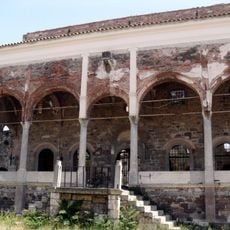
The castle's name is tied to Mytilene, the island's ancient city. Inside the Upper Castle, the Ottoman Kule Mosque was built over a church of Saint John from the Gattilusio period, which collapsed in an earthquake in 1867. North of it lie the remains of the sanctuary of Demeter and Kore, where five altars and dining halls for ritual meals were uncovered. The site now hosts local festivals in summer.
The lower section is accessible throughout the day without charge, while the upper and middle areas require entry through the West Gate. The hillside is steep in places, so comfortable footwear is recommended, and shade is limited once you start climbing.
The inner citadel, called Megas Perivolos, had five towers; the eastern one served as the castle's official residence. Its courtyard, the plateia magna, held the senate (curia), with the Loggia and Chancellery on its north side. A five-arched Ottoman gunpowder magazine now stands where the Loggia was.
The community of curious travelers
AroundUs brings together thousands of curated places, local tips, and hidden gems, enriched daily by 92,820 contributors worldwide.