Ancient theatre of Philippi, Ancient theatre at archaeological site in Kavala Municipality, Greece
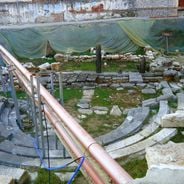
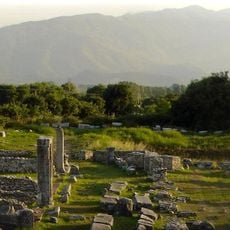
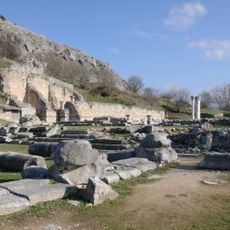
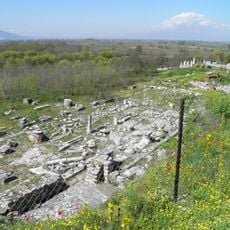
The Ancient theatre of Philippi was built in the mid-4th century BC at the foot of the acropolis, oriented south to give spectators a panoramic view of the city. Its surviving Greek retaining walls support the cavea, while a three-storey Roman stage building with a wooden proscenium was added in the 2nd century AD. The cavea is divided by a diazoma into two sections of eight kerkides each, with ten rows of seats below and an estimated ten to twelve above.
The theatre was built in the mid-4th century BC, in the first phase of the city after Philip II renamed it Philippi in 356 BC. In the 2nd century AD, at the city's peak, a three-storey stage building with a wooden proscenium was added and the seating was extended over the side entrances. Later in the same century or the early 3rd, the proscenium was demolished and the orchestra made circular for gladiatorial shows.
The Festival of Philippi-Thasos began in 1957, when an ancient drama was staged in the theatre for the first time in 24 centuries; the festival was officially inaugurated in 1961. Performances continue in the marble cavea, whose lower section has ten rows of seats divided into eight wedges.
The site is open daily with hours that vary by season, typically opening in the morning. It is wise to check current times ahead of your visit, as schedules differ significantly between winter and summer months.
In the 2nd or early 3rd century AD the Romans turned the theatre into an arena: the stage front was demolished, the orchestra made circular, the first two rows of seats removed and a stone parapet with railings added to protect spectators. A drain found around the paved orchestra carried off rainwater.
The community of curious travelers
AroundUs brings together thousands of curated places, local tips, and hidden gems, enriched daily by 92,952 contributors worldwide.