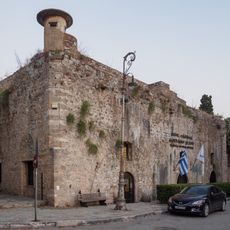
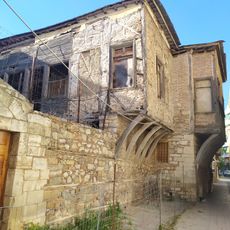
Church of Agia Paraskevi, Eastern Orthodox church in Chalkida, Greece
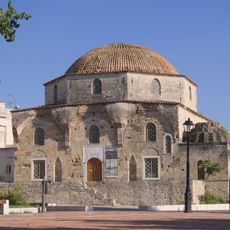
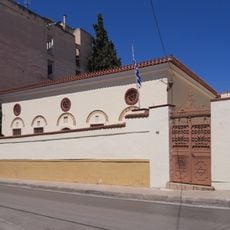
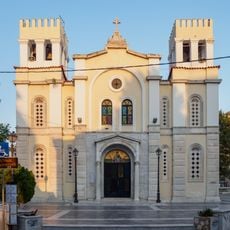
The Church of Agia Paraskevi is a religious building in Chalkida that combines Gothic and Byzantine architectural elements in an unusual way. The structure features carved stone details, distinctive arches, and a compact layout that reflects different building periods.
A 5th–6th-century early Christian basilica stood here; its column fragments and capitals with acanthus leaves survive. After the Frankish conquest of Euboea the church was rebuilt in Gothic style, and Latin sources identify it with the church of the Virgin, visited in Chalkida by Henri de Valenciennes in 1205. After the Ottoman conquest of 1470 it became a mosque dedicated to Mehmed the Conqueror, described by Evliya Çelebi in 1667 as the city's oldest mosque; in 1833 it returned to Christian worship as Agia Paraskevi.
The name recalls the Latin period, when the church was identified with a church of the Virgin, possibly Panagia Peribleptos; the crusader Henri de Valenciennes mentions visiting the church of the Virgin in Chalkida in 1205. After 1470 it served as a mosque, and since 1833 it has been dedicated to Agia Paraskevi.
The building is located on a protected archaeological site and is best visited during daylight when the carved stone details are most visible. It is advisable to dress respectfully when visiting, as it remains an active place of worship.
Two Byzantine capitals with Ionic volutes and a circular monogram stand in front of the facade, about 7 metres ahead of the present wall: they mark where the original Gothic front stood before the 1853 earthquake. The building was a mosque from 1470 until 1833, and the Ottoman traveller Evliya Çelebi described it in 1667 as the oldest mosque in Chalkida.
The community of curious travelers
AroundUs brings together thousands of curated places, local tips, and hidden gems, enriched daily by 94,027 contributors worldwide.