Aulis, Archaeological site in Chalkideon Municipality, Greece
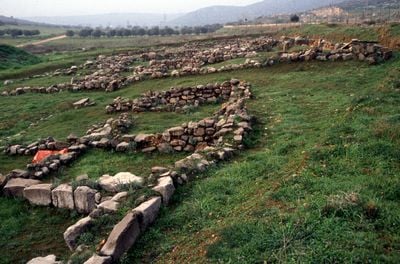
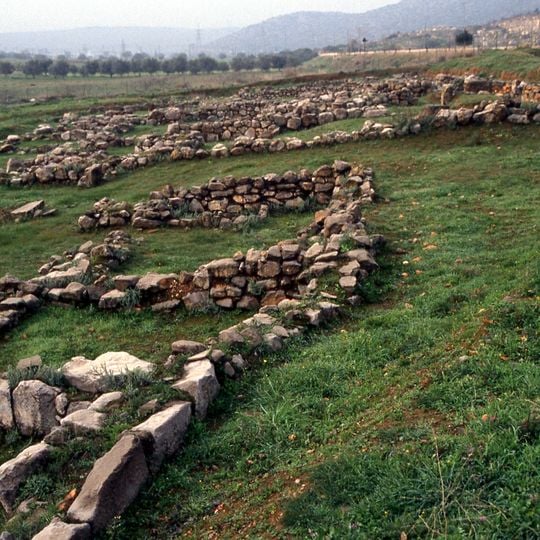
Aulis is an ancient port site at Mikro Vathy, near Agios Nikolaos in Chalkideon Municipality. Low, ruined walls of roughly stacked grey and brown stones form irregular, joined enclosures across a grassy slope, broken into segments with gaps; the stones are partly covered by grass and bare earth. No temple remains are visible.
Aulis was a Boeotian port at the Euripus Strait, opposite Euboea, near modern Mikro Vathy. It never became an independent polis, belonging to Thebes in 378 BC and later to Tanagra. In 396 BC the Spartan king Agesilaus II chose it as his departure point for Asia, but Thebans drove him out of Boeotia. By Pausanias's time only a few potters lived there, and the temple of Artemis still stood.
Aulis was named, in local myth, after Aulida, daughter of the legendary Theban king Ogygus. Pausanias found a temple of Artemis there, said to have been founded by Agamemnon, and the town's few remaining inhabitants were potters. The Artemis sanctuary is the setting of the Iphigenia story, which drew the Spartan king Agesilaus II to choose Aulis as his departure point in 396 BCE.
The ruins lie on a grassy slope at modern Mikro Vathy/Ag. Nikolaos, opposite Euboea across the Euripus Strait, about 5 km from Chalcis. The low stone walls are unfenced and partly overgrown, so watch your footing on the uneven ground. There is little shade; go early in the day.
Strabo noted that Aulis harbour could hold only fifty ships, so the Greek fleet must have gathered at the larger Bathys limen nearby. In 396 BCE the Spartan king Agesilaus II chose Aulis to imitate Agamemnon's departure for Asia, but Thebans drove him out of Boeotia before he could sail.
The community of curious travelers
AroundUs brings together thousands of curated places, local tips, and hidden gems, enriched daily by 94,089 contributors worldwide.