Ancient Corinth, Greek archaeological site in Archaea Korinthos, Greece
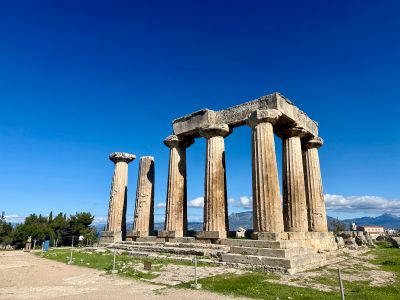
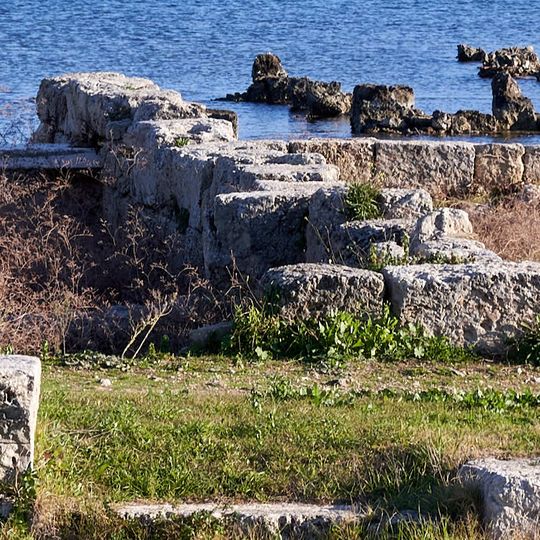
Ancient Corinth is an archaeological site in Archea Korinthos, Greece, with ruins of pale gray stone blocks and stepped foundations beside water. Seven fluted limestone columns with plain capitals stand in a row, six linked by horizontal blocks and the rightmost standing alone; a large fallen block patched with orange lichen lies in the foreground.
The city was founded in the 8th century BC and grew into one of the most important Greek trading centers on the isthmus between two seas. After its destruction in 146 BC by Roman forces, it lay abandoned for a century before Julius Caesar refounded it as a Roman colony in 44 BC.
The well-preserved columns of the Apollo temple remind visitors of how religious life shaped the daily routines of ancient Greeks who worshiped one of their most important gods here. Travelers today can still walk through the former marketplace where merchants from across the Mediterranean traded goods and philosophers gathered to debate.
The excavation area covers large grounds that are explored on foot and require sturdy footwear. Visitors should plan time for the adjacent museum, which displays finds from different periods of the settlement.
Pausanias records a Corinthian myth in which Briareus, one of the Hecatoncheires, arbitrated a dispute between Poseidon and Helios: the isthmus, nearest the sea, went to Poseidon, while Acrocorinth, nearest the sky, went to Helios. The Upper Peirene spring inside the acropolis walls was, he says, placed there by Asopus.
The community of curious travelers
AroundUs brings together thousands of curated places, local tips, and hidden gems, enriched daily by 93,025 contributors worldwide.