Arkoudiotissa Cave, Ancient religious cave in Akrotiri, Greece.
Arkoudiotissa is a cave in the Akrotiri municipality of Crete, reached on foot from Gouverneto Monastery. Its name comes from a stalagmite inside that is said to look like a bear. The cave was used for worship in ancient times and later dedicated to the Arkoudiotissa Panaghia.
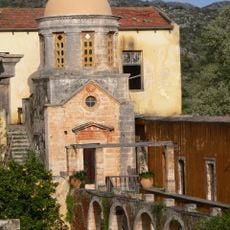
Arkoudiotissa was used for worship from ancient times, with evidence of cults of Artemis and Apollo. In the Christian era the cave was dedicated to the Arkoudiotissa Panaghia (Our Lady), and ascetics lived in the caves of the area. Further along the path, after a descent of 140 steps, stands the abandoned Katholikon, a monastic church believed to date from the 5th or 6th century and founded by St John the Hermit.
The cave's name comes from the Arkoudiotissa Panaghia, the "She-Bear" Our Lady to whom it was dedicated in the Christian era; the bear-shaped stalagmite gave the name. Ascetics lived in the caves of this area, and the site had earlier been used for cults of Artemis and Apollo.
The cave is reached on foot from Gouverneto Monastery; no road leads to it. Beyond the cave, the path continues down 140 steps to the abandoned Katholikon, the third monastery, built into the cliff. The ground is rocky and the descent steep, so allow time for the return climb.
The cave's name comes from a stalagmite that, seen from a certain angle, looks like a bear—"arkouda" in Greek—bending over. The formation stands inside the cave rather than at the entrance, and it is the reason the cave is called Arkoudiotissa, "she-bear."
The community of curious travelers
AroundUs brings together thousands of curated places, local tips, and hidden gems, enriched daily by 92,922 contributors worldwide.