Château Pastré, 19th-century bastide in Montredon, Marseille, France
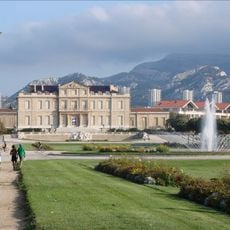
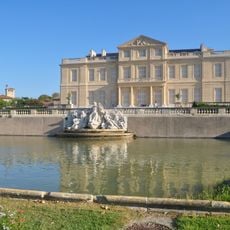
Château Pastré is a three-storey bastide completed in 1862, its symmetrical facade combining orange Marseille brick with pale Arles stone in curved bands. A projecting central section with a curved pediment and round-arched ground-floor openings faces a gravel forecourt; the building has been closed to the public since 2013.
Eugène Pastré (1806–1868) and his wife Céline de Beaulincourt-Marle had the château built as the largest of three houses on the 120 hectares they assembled between Pointe Rouge and the Grotte Rolland from 1836. The Parisian architect Jean-Charles Danjoy completed it in 1862. The city of Marseille bought the property between 1966 and 1987 and had the building restored.
The château is also known as Château de Montredon, after the suburb where it stands. On 27 July 1942, Countess Lily Pastré staged A Midsummer Night's Dream here, with costumes made by a young Christian Dior from the château's own draperies and music by the Orchestre National de la Radiodiffusion Française under Manuel Rosenthal.
The château itself has been closed to the public since the faience collection moved to Château Borély in 2013, so visits concern the surrounding Campagne Pastré park, whose central avenue from the entrance to the building runs over 900 metres. The park mixes 12 hectares of formal lawns, woods and two artificial lakes with 100 hectares of more natural vegetation, plus playgrounds and hiking trails.
The château stands at the end of a central avenue over 900 metres long, and the forested part of the park belongs to the Calanques World Heritage Site. The building itself is closed to the public since the faience collection moved to Château Borély in 2013.
The community of curious travelers
AroundUs brings together thousands of curated places, local tips, and hidden gems, enriched daily by 92,941 contributors worldwide.