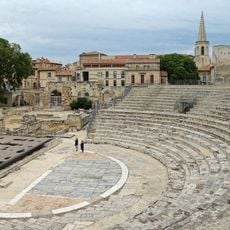
Arles Amphitheatre, Roman amphitheatre in Arles, France.
The Arles Amphitheatre is a two-tiered Roman amphitheatre of pale, weathered stone, 136 m long and 109 m wide, with 120 arches and a single annular gallery instead of the Colosseum's double outer gallery. Its crowning attic is gone, and a square medieval tower rises from the top. A broad flight of steps leads to the lower arcade, where a gated passage and posters sit between the arches.
The amphitheatre was built around 80–90 AD under the emperor Domitian, on the Hauture hill, after demolishing the Augustan town wall. It stayed in use for games until about 550, when it became a fortress with four towers; more than 200 houses and two chapels filled the arena. Expropriation began in the late 18th century and ended in 1825 under mayor Baron de Chartrouse; the last houses were demolished in 1840.
The name Arènes comes from the bull spectacles held here from 1830, when a bull race marked the taking of Algiers. Today the Feria d'Arles brings bullfighting to the arena, and summer brings plays and concerts; the site also hosted the TV game show Intervilles in 1998 and 2005.
The arena sits on the Hauture hill, reached by a broad flight of stone steps; inside, a single annular gallery on each of the two levels leads to the terraces by staircases alternating with vertical passages. The crowning attic has disappeared, so the upper arcades open to the sky. Look for the medieval tower rising above the arcades.
During medieval times, people actually lived within the ancient walls, transforming the structure into a fortified settlement rather than an entertainment venue. This unusual adaptation made the amphitheatre a residential space for roughly 200 families across several centuries.
The community of curious travelers
AroundUs brings together thousands of curated places, local tips, and hidden gems, enriched daily by 92,883 contributors worldwide.