Langlois Bridge, Wooden drawbridge near Arles, France
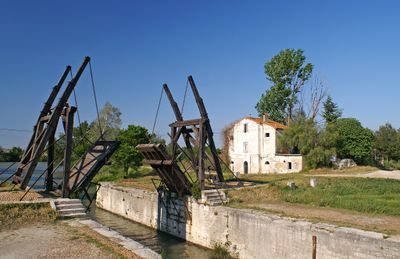
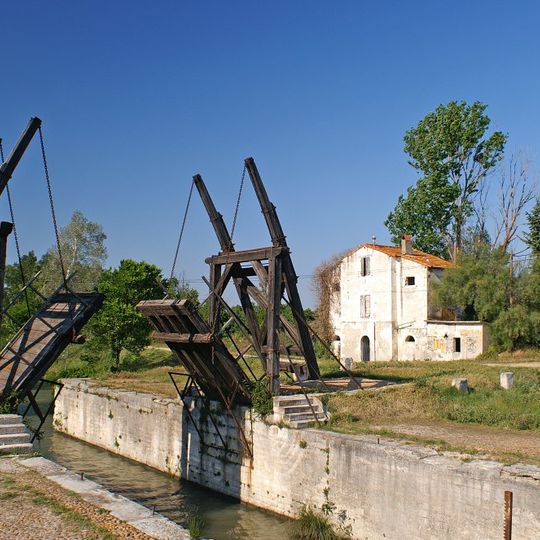
The Langlois Bridge, now called Pont Van-Gogh, is a wooden double-leaf drawbridge on the Arles–Bouc canal. Two angled A-frame trestles carry chains to the deck, whose two four-metre leaves tilt upward toward the centre; the counterweights sit high and the bearings rest on masonry. The span is eight metres, the trestles about five metres tall.
A Dutch engineer built eleven identical wooden drawbridges along the Arles–Bouc canal in the 1820s–1830s. The bridge van Gogh painted, kept by a man named Langlois, was demolished in 1926 and replaced in 1930 by the 45-metre concrete Pont de Réginelle. The surviving Fos-sur-Mer bridge, spared in 1944, was dismantled in 1959, bought by Arles, re-erected in 1962 and fully restored in 1997.
Vincent van Gogh painted this bridge several times in 1888, drawing inspiration from Japanese woodblock prints in his use of flat color and strong outlines. Visitors standing on the canal bank can line up almost the same view that appears in those paintings.
The bridge is open to both vehicles and pedestrians, and the canal bank offers a comfortable spot to take in the full view of the structure. Morning light tends to fall across the water at a low angle, making it a good time to visit if you want to see the setting at its clearest.
The bridge seen today is not the one Van Gogh painted: that structure was demolished in 1926 and replaced in 1930 by the 45-metre concrete Pont de Réginelle. The present wooden span is the sole survivor of the eleven canal bridges, the one at Fos-sur-Mer, dismantled in 1959 and re-erected near Arles in 1962. Its lifting posts rise about five metres, and the two four-metre flaps open to a four-metre passage.
The community of curious travelers
AroundUs brings together thousands of curated places, local tips, and hidden gems, enriched daily by 93,359 contributors worldwide.