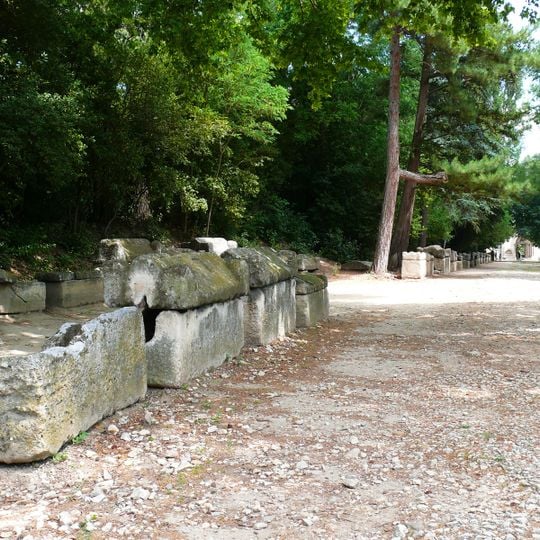
The Alyscamps, Roman necropolis in Arles, France.
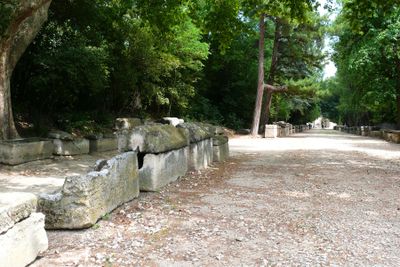
The Alyscamps is a Roman necropolis outside the old walls of Arles, aligned along the final stretch of the Aurelian Way. Two rows of pale grey and beige stone sarcophagi line a wide dirt path; many are hollowed troughs with thick rims, while others lie broken into separate blocks. The left row sits atop a low stone wall, with heavy lids and fragments stacked in the foreground, and tall trees rise behind it.
The Alyscamps was Arles' main burial ground for nearly 1,500 years, from the Roman era until the Middle Ages. Saint Genesius, beheaded in 303, was buried there and his cult drew burials from across Europe. In 1152 the transfer of Saint Trophimus' relics to the cathedral reduced its prestige, and from the Renaissance the site was looted for its sarcophagi.
The name Alyscamps derives from the Provençal Aliscamps, from Latin Elisii Campi, the Elysian Fields. In the Middle Ages the necropolis was a required stop on the Compostela pilgrimage for Provençal pilgrims. In 2018 Gucci presented its Cruise 2019 collection with a fashion show held among the sarcophagi.
The site is an open-air museum with a wide dirt path running between two rows of sarcophagi; the left row sits on a low stone wall, the right row rests on the ground. The ground is uneven among the stone blocks, so wear sturdy shoes. The railway and the Craponne canal cut across the site in the 19th century, so parts of the necropolis lie on either side of these crossings.
The claim that Christ attended Saint Trophimus's burial and left the imprint of his knee on a sarcophagus lid drew pilgrims to the site. The better surviving sarcophagi are now held by the Musée de l'Arles et de la Provence antiques, whose Roman collection is among the largest outside Rome.
The community of curious travelers
AroundUs brings together thousands of curated places, local tips, and hidden gems, enriched daily by 93,377 contributors worldwide.