Axe historique, Sightline in Paris and Hauts-de-Seine, France
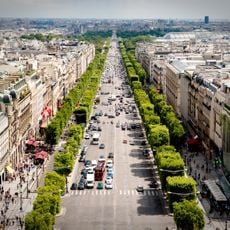
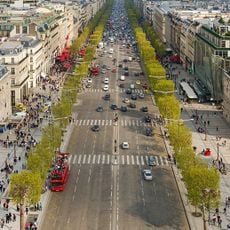
The Axe historique is a straight line running from the Louvre Museum through central Paris to the business district of La Défense. It passes through several major squares and wide streets, connecting notable buildings and public spaces in a continuous perspective.
Catherine de' Medici began the axis in 1564 with the Tuileries Palace and its geometric gardens. André Le Nôtre extended the vista west as the Champs-Élysées around 1670, the Place de la Concorde followed under Louis XV, and the Arc de Triomphe was completed in 1836. The Tuileries Palace burned in 1871 and was not rebuilt; the axis was later carried to La Défense, where the Grande Arche opened in 1989.
The name Voie Triomphale ("triumphal way") comes from the military monuments placed along the line, from Napoleon's Arc de Triomphe du Carrousel to the Arc de Triomphe. The axis also gives Paris its "Paris henge": twice a year the setting sun aligns behind the Grande Arche. Metro Line 1, opened in 1900 between Vincennes and Neuilly, follows the same east-west route.
The best way to experience this axis is to walk along it from one end to the other, viewing the sight lines and buildings from different vantage points. Metro Line 1 runs the full length of the route and offers shortcuts if you need a break.
While most buildings align perfectly along a straight line, the Grande Arche at La Défense sits at a slight angle to the rest, showing that even carefully planned projects must adapt to modern needs. This small irregularity is hardly noticeable but it shows that urban planning requires balancing rigid geometry with practical flexibility.
The community of curious travelers
AroundUs brings together thousands of curated places, local tips, and hidden gems, enriched daily by 94,141 contributors worldwide.