Église Notre-Dame-des-Accoules, Gothic church in Panier district, Marseille, France.
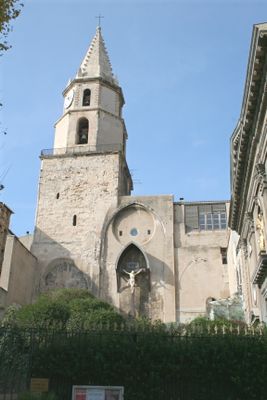
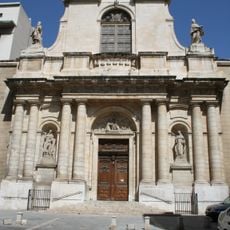
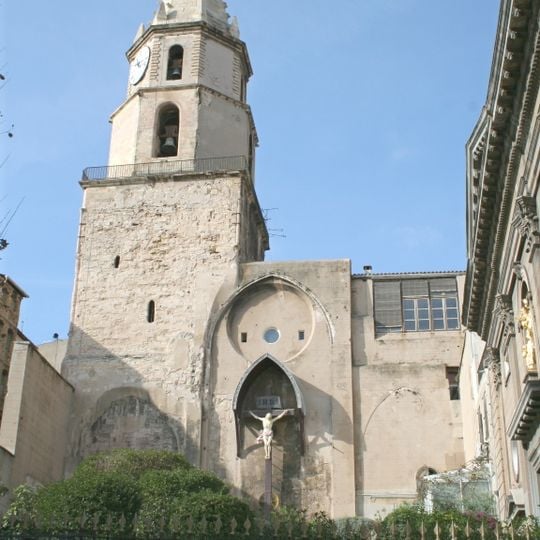
Église Notre-Dame-des-Accoules is a Gothic church on place Daviel in Marseille's 2nd arrondissement. Its pale stone facade rises to a square bell tower on the left, with a clock face near the top, two arched openings below it and a projecting ledge above the main body. The facade has a shallow pointed-arch recess with a small circular opening and two square slots, and a deeper pointed archway holds a crucifix; a low green hedge runs along the base. The medieval church was demolished from 1794, leaving only the tower and the rear wall with the pointed-arch traces of its three naves; a new church was built beside the calvary from 1824.
A 1205 inscription on a preserved column records a reconstruction of the medieval church, probably rebuilt in the 14th century in southern Gothic style with five bays and flying buttresses. In 1793 it hosted a federalist sectional assembly; by decree of 6 January 1794 it was demolished, the contract awarded to J.-Ch. Caillol on 2 May 1794, and work dragged on until 1808. The bell tower was spared because its clock told the time for the port works, and it was listed as a monument historique on 7 July 1964.
The name Accoules most likely comes from the Latin description of the church's structure, built quasi per angulos et arcuatim, in angled arches; a rival theory links it to a spring once flowing nearby. In 1820 the missionary abbé de Forbin-Janson, back from Palestine, had a rockwork calvary with a large crucifix raised here, and the square became a pilgrimage site. The cross was planted on 27 February 1820 after a procession across the city.
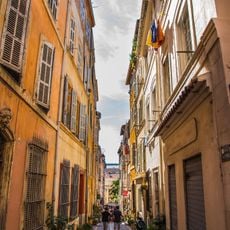
The best way to visit is on foot from Rue de la Prison, where the facade and tower are visible from different angles. The surrounding area is part of the lively Panier quarter with narrow streets, so exploring on foot at quieter times works well.
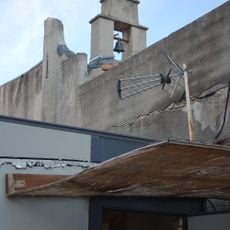
The bell tower survived the 1794 demolition only because its clock told the time for the port works and the city. The rear wall of the destroyed church still shows the pointed-arch traces of its three naves, and the 1820 Calvary against it was inspired by a voyage to Palestine.
The community of curious travelers
AroundUs brings together thousands of curated places, local tips, and hidden gems, enriched daily by 93,952 contributors worldwide.