Musée d’Archéologie Méditerranéenne, Archaeological museum in 2nd arrondissement, Marseille, France
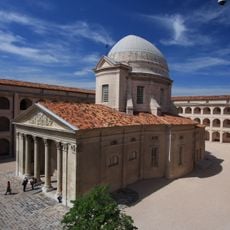
The Musée d'Archéologie Méditerranéenne occupies the first floor of the Vieille Charité in Marseille, whose pale stone facade rises in tiers of round-headed arches on square piers, with vaulted galleries behind. Inside, five enfilade rooms evoke an Egyptian temple; the last represents a funerary chamber. The collection includes a 5.64-metre papyrus with a funerary oracle from the 26th dynasty and a black granite statue of Ramesses VI.
The museum opened in 1995 on the first floor of the Vieille Charité. Its Egyptian collection comes from Antoine Barthélémy Clot (1793–1868), who founded the medical school in Egypt at the request of Méhémet Ali; Marseille bought his objects cheaply, later adding gifts and purchases. The classical department covers the Near East, Etruria and Cyprus, whose 185 pieces span two thousand years.
The Egyptian rooms are modelled on Egyptian temples, and the last of the five enfilade rooms represents a burial chamber. Look for the 5.64-metre papyrus with a funerary oracle from the 26th dynasty and the mummified crocodiles. A separate room holds the Celtic-Ligurian pieces from the Roquepertuse oppidum, including pillars with oval niches for displaying skulls.
The museum occupies the first floor of the Vieille Charité, reached by stairs or lift from the courtyard; the Egyptian rooms follow one another in a suite of five, ending in a burial chamber. The African, Oceanian and Amerindian museum is on the floor above, so both can be seen in one visit.
The building itself, the Vieille Charité, was originally a poorhouse from the 17th century and later transformed into a cultural center. This history makes the site more than just a museum—it reflects Marseille's urban transformation over centuries.
The community of curious travelers
AroundUs brings together thousands of curated places, local tips, and hidden gems, enriched daily by 93,850 contributors worldwide.