Maison Diamantée, Private mansion in Old Port district, Marseille, France
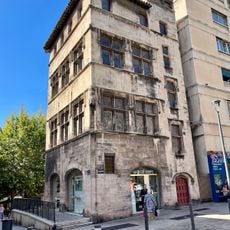
Maison Diamantée is a four-level stone building on rue de la Prison, directly behind Marseille's city hall. Its light-beige facade is covered entirely in rough-cut stones projecting in a diamond pattern, with an arched side door and a central dark wooden double door at ground level, three groups of tall windows on the first floor, a row of windows above, and small square windows under a low tiled roof edge.
The Maison Diamantée, with the Hôtel de Cabre, is one of Marseille's oldest preserved dwellings. It was built on the former gardens of the Palais de Provence, probably at the end of the 16th or start of the 17th century, for wealthy patrons of Spanish and Italian origin; the Chinese Wikipedia names the Catalan merchant Pierre Cardiolle and dates it 1570–1576. It later belonged to Marseille families including Pierre Sebolin de Bollena, second échevin in 1683, his nephew François de Saboulin Bollena, first échevin in 1702, and the Castellane Majastre. In 1914 the rundown house was bought by the association Art et Charité, which bequeathed it to the Comité du Vieux-Marseille; in 1943 the German authorities spared it when clearing the Old Port's north bank. It was listed as a historic monument on 10 November 1925.
The building's name comes from its facade of stones cut into projecting diamond points, called prismatic bossing. From 1967 to 2009 it housed the Musée du Vieux Marseille, whose collections then passed to the Musée d'Histoire de Marseille. Oral tradition calls it the palace of King René, Count of Provence, a claim the sources do not support.
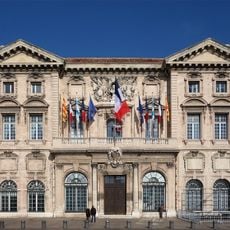
The Maison Diamantée stands at 2 rue de la Prison, directly behind Marseille's city hall in the Hôtel de Ville quarter, in the 2nd arrondissement. The diamond-faceted facade is seen from the narrow street, so step back toward the town hall square to take in the four levels. The building is not open as a museum; its ground-floor doors are closed to casual visitors.
Oral tradition long identified the house as the palace of King René, Count of Provence, though it was built roughly a century after his death. The pink limestone and white stone of the facade, cut into projecting diamond points, gave the building its name.
The community of curious travelers
AroundUs brings together thousands of curated places, local tips, and hidden gems, enriched daily by 92,939 contributors worldwide.