Collège des Bernardins, Medieval college building in Latin Quarter, Paris, France
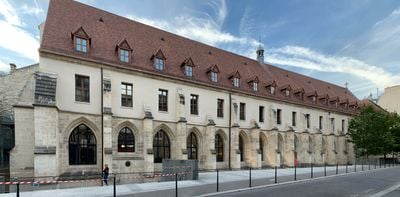
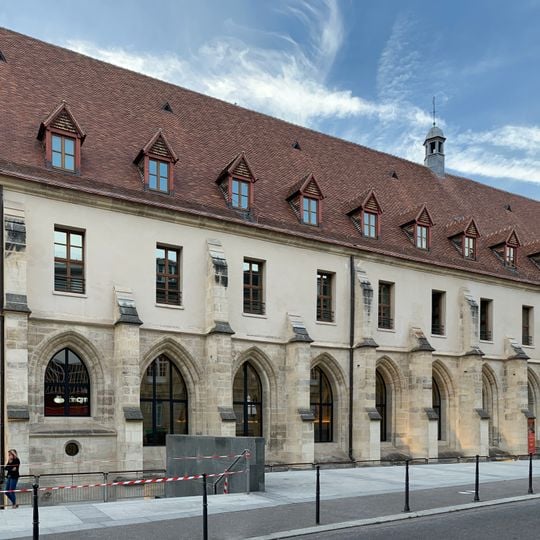
The Collège des Bernardins is a former Cistercian college at 20 rue de Poissy, built from 1248 under Étienne de Lexington. Its surviving main building has a pale beige facade with a red tiled roof, dormer windows and a small domed lantern; below, two rows of rectangular windows sit above pointed Gothic arches divided by buttresses on projecting stone bases.
Étienne de Lexington, abbot of Clairvaux, founded the college and began construction in 1248 with Pope Innocent IV's encouragement; the main body was finished around 1253. The church, begun under Benedict XII in 1338, was left unfinished and later demolished. Confiscated in 1790, the site became a prison where 70 of 73 galley slaves were killed in the September 1792 massacres.
The name Bernardins comes from the Cistercians, also called Bernardines after Saint Bernard of Clairvaux. Since 2009 the site has housed the Académie catholique de France, and the École Cathédrale teaches Christian thought to more than 3,000 students each year. The former cellar, described as the largest in Paris, now serves as a study space for students and researchers.
The entrance is at 20 rue de Poissy, between rue des Écoles and boulevard Saint-Germain. The 2004–2008 renovation by Hervé Baptiste and Jean-Michel Wilmotte added a 4,500 m² space with classrooms and an auditorium under the roof. The medieval cellar, described as the largest in Paris with three naves, can be visited; its excavation revealed a diversion canal of the Bièvre.
The 2004–2008 renovation placed 322 steel micropiles, 15 to 25 metres deep, under every exterior wall and pillar. Digging in the basement for this work uncovered Roman vaults that had sunk into the soft alluvial ground, and a diversion canal of the Bièvre, explaining why the building had been settling since its construction.
The community of curious travelers
AroundUs brings together thousands of curated places, local tips, and hidden gems, enriched daily by 93,400 contributors worldwide.