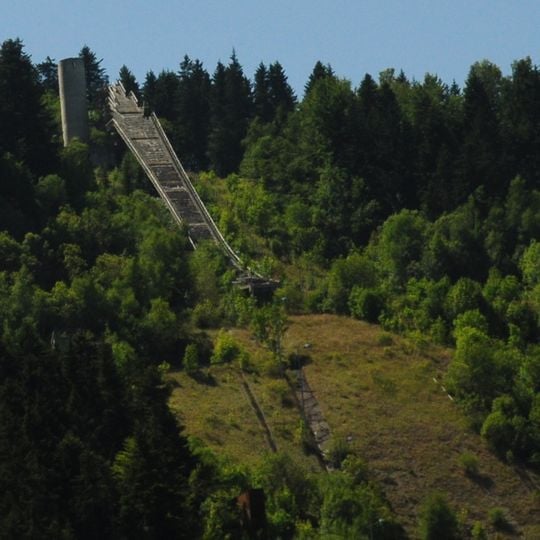
Dauphine, Former Olympic ski jumping hill in Saint-Nizier-du-Moucherotte, France
Dauphine is a ski jumping hill in the mountains above Saint-Nizier-du-Moucherotte, in the Auvergne-Rhône-Alpes region of France. The concrete structure consists of a tall inrun tower, a takeoff ramp, and a long landing slope that runs down the hillside.
The hill was built in 1966 to a design by German architect Heini Klopfer and hosted the ski jumping events of the 1968 Winter Olympics in Grenoble. After the Games it was rarely used and gradually fell into disrepair over the following decades.
The hill takes its name from the Dauphiné, the historic province of Saint-Nizier-du-Moucherotte. Its opening event, the Internationale Springertage of January 1967, was won by Norway's Bjørn Wirkola with a jump of 99 m, after Max Bolkart had passed 100 m in training. The Olympic individual competition was held here on 18 February 1968 before about 70,000 spectators.
The site sits on a mountain slope and can be reached on foot via hiking paths, so sturdy shoes are a good idea. Conditions can change with the season, and parts of the structure may be off-limits, so checking locally before the visit is worth the effort.
The hill's K-point was raised to 112 metres in the 1970s, after the Olympics. Its last World Cup events were held on 9 and 10 February 1980, won by Piotr Fijas and Tom Christiansen, and on 28 February 1981, won by Roger Ruud. Two World Cup contests planned for January 1982 were cancelled for lack of snow.
The community of curious travelers
AroundUs brings together thousands of curated places, local tips, and hidden gems, enriched daily by 93,508 contributors worldwide.