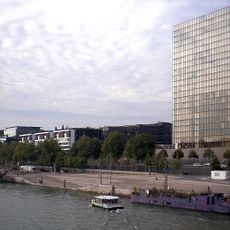
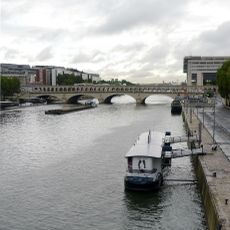
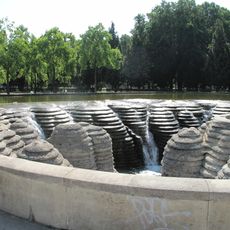
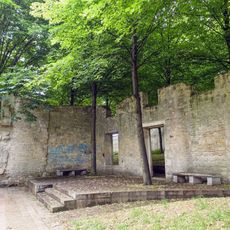
Passerelle Simone-de-Beauvoir, Pedestrian bridge in Bercy and Gare districts, Paris, France.
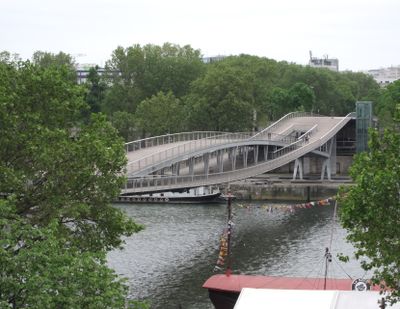
Passerelle Simone-de-Beauvoir is a 304-metre pedestrian and bicycle bridge over the Seine, linking the 12th and 13th arrondissements. Its central span is a 106-metre steel lens, 12 metres wide, formed by a lower catenary in tension and an upper arch in compression. The deck runs on light wooden planks between chain-link railings, and the five spans cross the river without any support in the water.
An international architecture competition in 1998 led to the bridge's design, with construction supervised by architect Dietmar Feichtinger between 2004 and 2006. Its completion created a new link between two evolving neighborhoods on opposite sides of the river.
In March 2005 mayor Bertrand Delanoë proposed naming the bridge after Simone de Beauvoir, and he inaugurated it on 13 July 2006 in the presence of her adoptive daughter Sylvie Le Bon de Beauvoir. The municipal decree of 1 June 2006 made the name official. The provisional name had been passerelle Bercy-Tolbiac.
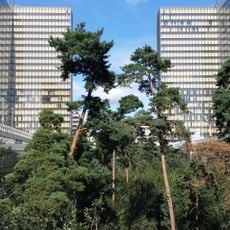
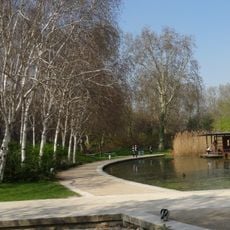
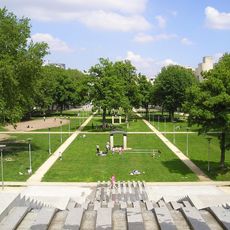
The bridge has five spans and no pier in the water, so the crossing is uninterrupted. It lands directly on the parvis of the Bibliothèque François-Mitterrand on the left bank and in the parc de Bercy on the right bank, with double supports on the lower quays. A sheltered area mid-way in the central lens lets pedestrians wait out rain. The nearest Metro station is Quai de la Gare.
The central section of the bridge was manufactured at the Eiffel plant in Alsace and traveled an unusual route to reach Paris. It was transported through North Sea canals and rivers before final assembly on the Seine.
The community of curious travelers
AroundUs brings together thousands of curated places, local tips, and hidden gems, enriched daily by 93,431 contributors worldwide.