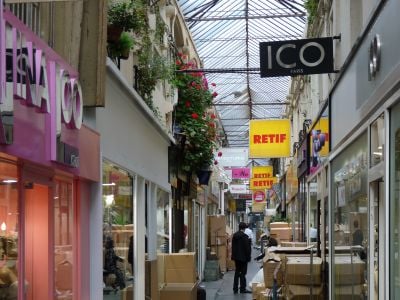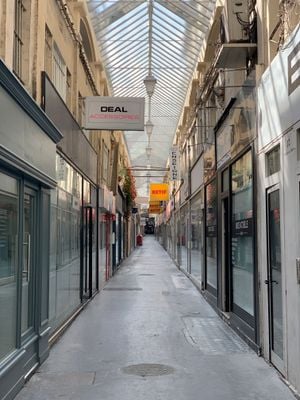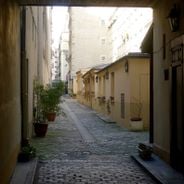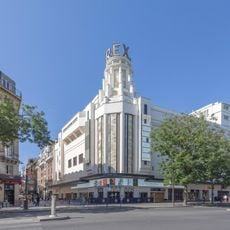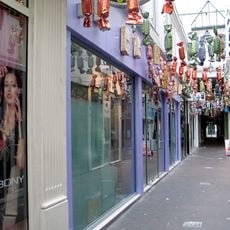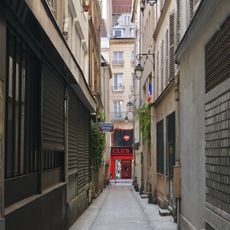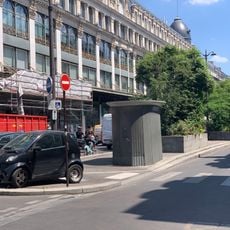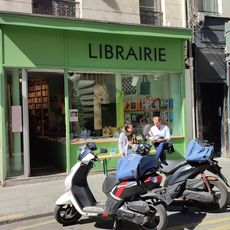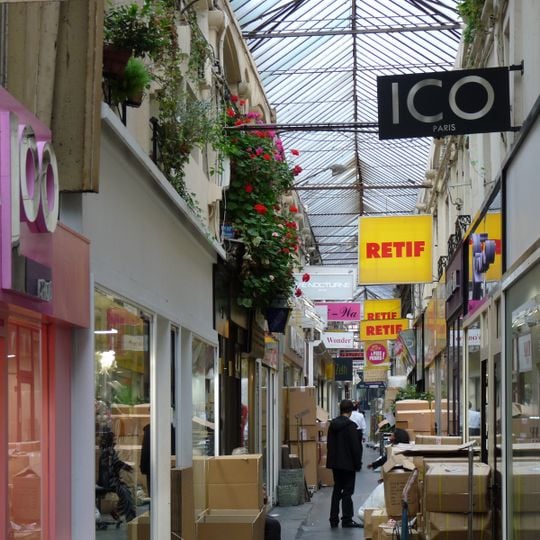
Passage du Caire, Covered passage in the 2nd arrondissement, France.
Passage du Caire is a covered passage in the 2nd arrondissement, running between Place du Caire, Rue du Caire, Rue Saint-Denis and Rue d'Alexandrie. It is 370 metres long and 2.70 metres wide on average, making it the longest and one of the narrowest covered passages in Paris. It has three galleries—Saint-Denis, Sainte-Foy and du Caire—meeting at a rotunda, and a glass roof partly renovated in 2014.
Opened at the end of 1798 on the site of the Filles-Dieu convent, the passage was named in memory of the French entry into Cairo on 23 July 1798. It was first called "passage de la Foire du Caire". Initially occupied by artisans, from the 1840s printing and lithography became its main industry, before clothing wholesalers took over in the 20th century.
The name recalls the French army's entry into Cairo on 23 July 1798, and the facade on Place du Caire carries three effigies of the goddess Hathor with cow ears. The passage was first called "passage de la Foire du Caire". Léo Malet sets a scene here in Des kilomètres de linceuls, where Nestor Burma stumbles over a corpse in a gallery around three in the morning.
The passage has four entrances: Place du Caire, Rue du Caire, Rue Saint-Denis and Rue d'Alexandrie. It is a private way open to pedestrians Monday to Saturday, 8am to 8pm, under a 2014 agreement with the City of Paris. The nearest metro station is Sentier on line 3.
The paving of the three galleries incorporates tombstones from the nuns of the Filles-Dieu convent, on whose former grounds the passage was built. The site also inspired a scene in Léo Malet's novel "Des kilomètres de linceuls", where Nestor Burma stumbles over a corpse in the passage around three in the morning.
The community of curious travelers
AroundUs brings together thousands of curated places, local tips, and hidden gems, enriched daily by 93,897 contributors worldwide.