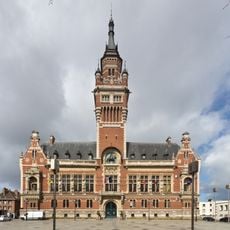
Belfry of Dunkirk, Gothic bell tower in Dunkirk, France.
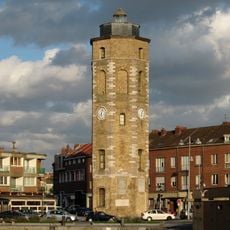
The Belfry of Dunkirk is a 58-metre Gothic tower of light brown brick with lighter stone accents, rising in a square, tiered form. Its base measures 15 metres across and narrows to 8 metres at the top, on foundations 1.70 metres deep. A pointed-arch portal with a recessed doorway and a smaller arched entrance sits below a circular clock face; higher up, tall narrow louvered windows and a second clock face lead to a flat roof with a small flag.
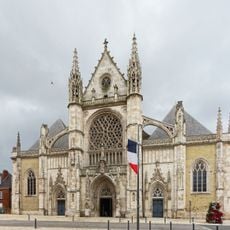
A watchtower and seamark existed here by 1233, with a beacon lit at night and the Garcia family keeping watch for 600 years. Around 1450 the tower was raised to 58 metres and became the bell tower of Saint-Eloi. The church burned in 1558 when Marshal de Thermes took the city; the tower survived, and the rebuilt church was never joined to it. The 1853 carillon was destroyed in 1940.
The carillon is played automatically every quarter of an hour: the cantata to Jean Bart on the hour, then "Ta lire, ta loure" to the tune of "Polichinelle", the air of the Dunkirk carillon, and the air of the Reuze. The 50 bells, cast by Paccard in Annecy, hang in the tower that still serves as the bell tower of Saint-Eloi.
The tower is typically accessible only through arranged tours, so planning ahead is advisable before visiting. The climb involves numerous stairs, so comfortable footwear and a reasonable level of fitness are helpful for those who wish to reach the upper levels.
The carillon's largest bell, the bourdon Jean Bart, weighs 7 tonnes; the full set of 50 bells, cast by Paccard in Annecy, totals 17 tonnes. Since 2005 the bells span four octaves, and unless a concert is playing, a short melody rings automatically every quarter of an hour.
The community of curious travelers
AroundUs brings together thousands of curated places, local tips, and hidden gems, enriched daily by 93,471 contributors worldwide.