Dunkirk lighthouse, Maritime navigation lighthouse in Dunkirk, France
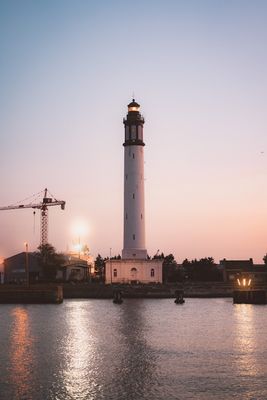
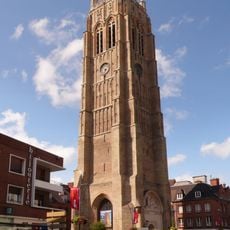
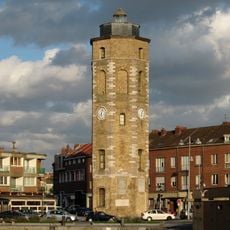
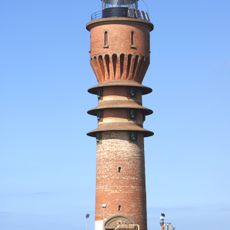
Dunkirk lighthouse is a cylindrical brick tower standing 63 m (about 207 ft) tall near the entrance to the city's harbor, making it one of the tallest lighthouses on the French North Sea coast. At the top, a black balcony surrounds a brown lantern room that still guides ships through the Channel.
The lighthouse was built from 1841 on the ruins of Fort Risban, a fortification Vauban had laid out from 1681, and entered service in 1843. Its architect was Léonce Reynaud, and it was one of the first towers erected under the 1825 French coastal lighting programme drawn up by Rossel and Augustin Fresnel. It was electrified in 1885, automated in 1985, restored in 1992 and classified as a monument historique on 19 April 2011.
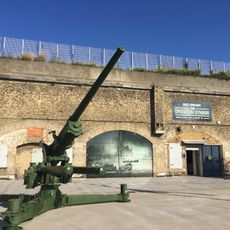
The lighthouse is nicknamed "bec à gaz" (gas burner) by some because of its double black-ringed crown topped by the lantern. Its former keeper building now displays busts of Augustin Fresnel and hydrographer Charles-François Beautemps-Beaupré, and since 2010 the tower forms part of the Musée du Port, with an exhibition on its history, its technology and the life of lighthouse keepers.
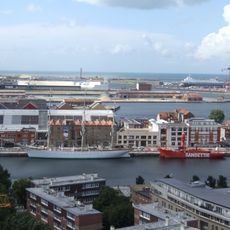
The lighthouse is open to visitors as part of the Musée du Port, with a reception area set up in 2012 that includes an exhibition on its history, technology and the lives of its keepers. A spiral staircase of 276 steps leads to the lantern, and explanatory panels inside cover the Dunkerque signalling centre. The climb rewards with views over the port, the sea and the Flanders hinterland.
Although the tower dates from the 19th century, it is still an active lighthouse with modern navigation equipment inside. This means a structure built in the age of steam ships continues to guide vessels through one of the world's busiest waterways today.
The community of curious travelers
AroundUs brings together thousands of curated places, local tips, and hidden gems, enriched daily by 92,847 contributors worldwide.