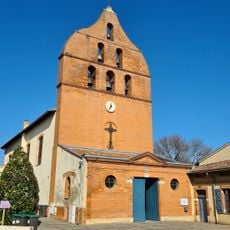
Château de Pibrac, Renaissance castle in Pibrac, France.
Château de Pibrac is a red-brick Renaissance castle in Pibrac, Haute-Garonne. Its central two-storey block has a flat roofline, with an entrance tower with a pointed roof on the left and a taller square tower on the right; a broader wing with a stepped gable stands further right. Rectangular windows with light stone surrounds pierce the brick, and a wide stone staircase of about a dozen steps climbs to a terrace wall at the base.
Construction began in 1540 under architect Nicolas Bachelier, reflecting Renaissance ideals of the time. The French Revolution brought significant changes when the tops of the towers were removed, altering the castle's original silhouette.
The Quatrains cabinet features 16th-century vaulted rooms decorated with mythological scenes that connected the castle to literary works of the period. The ornamental design shows how architecture and scholarship were intertwined in Renaissance life.
The castle is privately owned, so the interior is not open to visitors; the grounds and the English-style park laid out by Eugène Bühler in 1897, with terraces and a basin over 14 ha, open only at certain periods of the year. The brick Henri IV gate stands in the park.
The south wing's second floor has a gallery à jour, or mirande, an openwork brick screen. The central tower is faceted, and the inner courtyard angles carry échauguettes. The 16th-century portal has a vault of three arches, topped by a small terrace and flanked by two square pavilions joined by a triangular pediment.
The community of curious travelers
AroundUs brings together thousands of curated places, local tips, and hidden gems, enriched daily by 94,107 contributors worldwide.