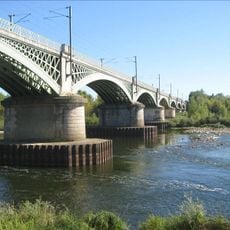
Pont-canal du Guétin, Navigable aqueduct in Cuffy, France.
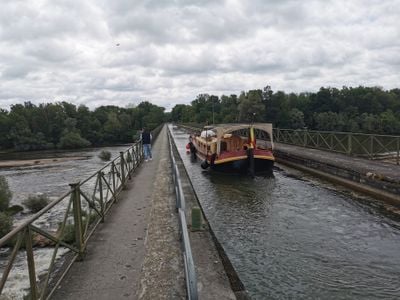
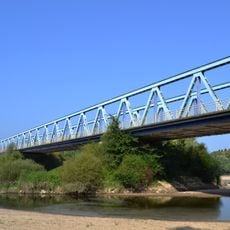
Pont-canal du Guétin is a stone structure that carries boats across the Allier River, lifting them above the water level instead of routing traffic around the obstacle. The crossing features multiple arches and wide enough dimensions to safely transport waterway vessels.
The canal bridge was designed by engineer Adolphe Jullien, then 29, under chief engineer Jean Joseph Pierre Vigoureux, and opened to navigation in 1838 with the Canal latéral à la Loire. Between 1880 and 1890 Léonce-Abel Mazoyer adapted it to the Freycinet gauge, raising the trough walls to deepen the water from 1.60 m to 2.20 m and replacing the three-chamber lock staircase with the double lock No. 21-22.
The waterway is part of a system that carries boats over rivers instead of directing traffic around them. Visitors can see this unusual solution, which shows how 19th-century engineers wanted to maintain continuous water routes.
The towpath runs along both sides of the trough, so you can walk across the bridge beside the water. The double lock No. 21-22 begins immediately northwest of the bridge and handles a drop of 9.50 m. A gate marked "PASSAGE INTERDIT" stands at the channel edge, so stay on the marked path.
The bridge's stone came from Apremont-sur-Allier, and its 18 arches each span 16 m at the base. The two locks just northwest, Nos. 21 and 22, replaced a three-chamber staircase during the 1880s rebuild and handle a 9.50 m drop.
The community of curious travelers
AroundUs brings together thousands of curated places, local tips, and hidden gems, enriched daily by 94,657 contributors worldwide.