Abbaye Toussaint d'Angers, Medieval abbey in Angers, France.
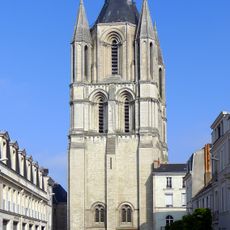
Abbaye Toussaint d'Angers is a former Augustinian abbey in Angers whose abbey church, rebuilt in the mid-13th century on a tau-shaped plan, still stands. Its facade has a pale upper section above a rough tan base, with a circular rose window ringed by radiating stone spokes and, above it, a steep grey slate pyramid roof ending in a slender spire. A lower wing to the left has arched openings along its base.
Founded in 1040 as an almonry called elemosinaria Omnorum Sanctorum, the house depended on the Abbey of the Trinity of Vendôme. Augustinian canons from the Diocese of Poitiers settled here in 1115, and the first abbot, Robert, was appointed in 1140. The abbatial church was rebuilt in the mid-13th century on a tau plan; the ruined church was classified as a monument historique in 1902.
The name Toussaint refers to All Saints; the founding charter of 1040 calls it "elemosinaria Omnorum Sanctorum", an almshouse. It was served by Augustinian canons, regular clergy following the rule of Saint Augustine, installed here in 1108. The first abbot, Robert, was appointed in 1140; his burial and that of a second abbot Robert were found in 1845 near the nave portal.
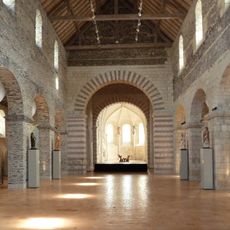
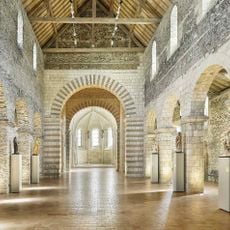
The abbey now houses the David d'Angers Gallery, which displays sculptures and artworks from renowned artist Pierre-Jean David in its galleries. You can walk through the historic spaces while viewing the collection displayed throughout the building.
The abbey church was rebuilt in the mid-13th century on a tau-shaped plan and still stands; a new timber frame with a glass roof saved it from complete destruction and allowed the David d'Angers gallery to move in from the museum of fine arts refectory in 1984.
The community of curious travelers
AroundUs brings together thousands of curated places, local tips, and hidden gems, enriched daily by 93,510 contributors worldwide.