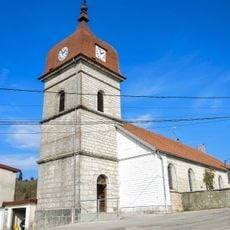
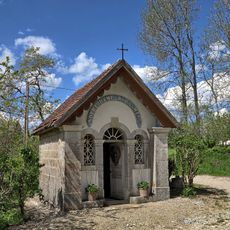
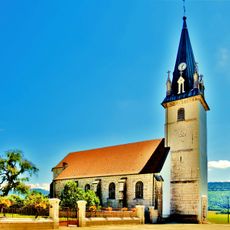
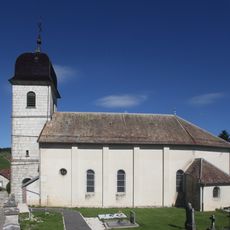
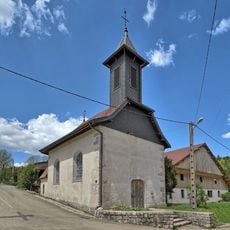
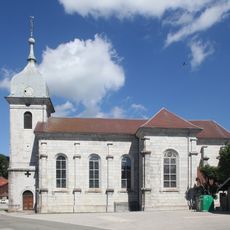
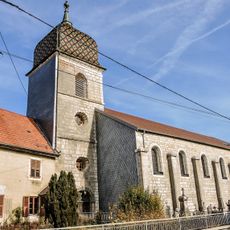
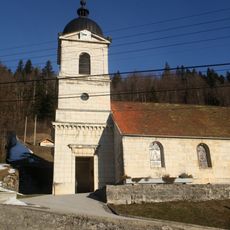
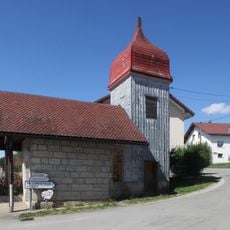
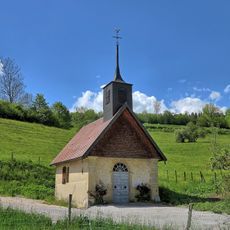
Abbaye de Montbenoît, Gothic church monument in Montbenoît, France.
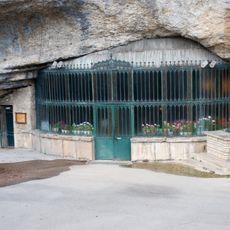
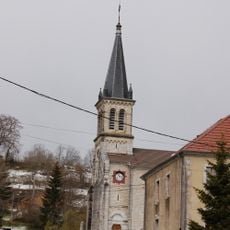
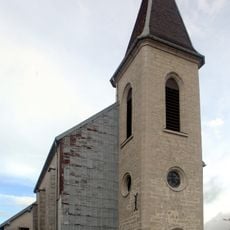
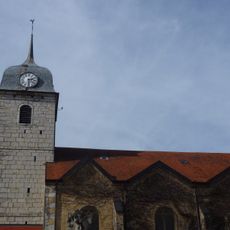
Abbaye de Montbenoît is an Augustinian monastery complex built from the 11th to the 20th century. Its square stone tower has a clock, a pointed-arch relief of a horseman, and three narrow windows; the church interior combines a 12th-century nave with a 16th-century Flamboyant Gothic choir and late-Renaissance carved stalls.
Around the year 1000 a hermit named Benoît built a retreat near the future site; disciples formed a Benedictine community that later adopted the Augustinian rule, documented by a charter of Henri de Joux in 1199. In 1251 a charter fixed the customs of the Saugeais, a seigneurie dependent on the monastery for 700 years. The interior was vandalised in the 17th century by Bernard de Saxe-Weimar's troops.
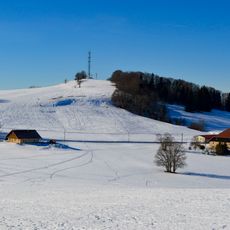
The abbey church keeps late-Renaissance carved oak stalls in its choir, and the name Saugeais comes from the monastery's former seigneurie. Since 1947 the area has formed the humorous République du Saugeais, whose president is elected in Montbenoît; the abbey remains its ceremonial heart.
The cloister has been a listed monument since 1846, the church since 7 November 1922, and the remaining buildings since 8 October 1935. The tower, with its clock and carved horseman relief, was separately registered on 23 August 2013. Look for the three pointed-arch windows and the two lanterns flanking the facade.
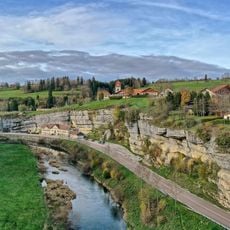
The Saugeais region around the abbey formed a single seigneurie under the monastery for 700 years. A charter of 1251 by Archbishop Guillaume II de la Tour and Amauri de Joux set the inhabitants' living conditions, and the prior Étienne declared himself a contemporary of the region's first settlers.
The community of curious travelers
AroundUs brings together thousands of curated places, local tips, and hidden gems, enriched daily by 93,786 contributors worldwide.