Gouffre Berger, Pit cave system in Engins, France
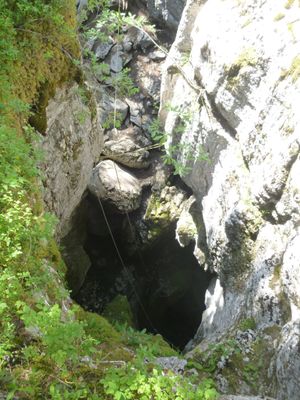
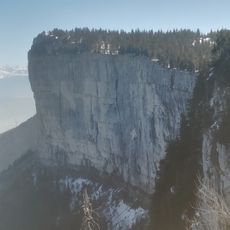
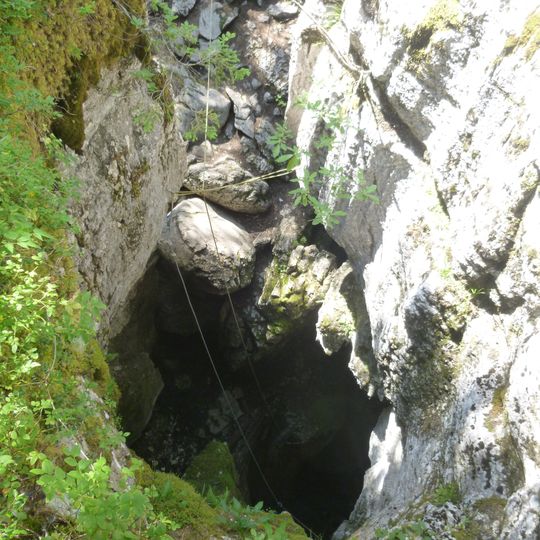
Gouffre Berger is a karst cave system on the Sornin plateau in the commune of Engins, at the northern end of the Vercors massif. Its main entrance is a vertical shaft between grey moss-covered limestone walls, with rounded boulders wedged above and ropes hanging into the dark. The network has eleven entrances and about 37 km of passages, formed by water dissolving Urgonian limestone into shafts and meanders that reach a collector at −234 m.
The cave system was discovered in 1953 by Joseph Berger and his team, holding the title of the world's deepest cave until 1964. Its connection to another cave system in 1990 transformed it into a far more extensive underground network.
The cave's name honours Joseph Berger, who found the entrance on 24 May 1953 with Georges Bouvet, Ruiz de Arcaute and Marc Jouffrey. Cavers have organised clean-up operations since 2013, and by the end of 2018 the Gouffre Berger was reported clean again. The site lies on the Sornin plateau, a biological reserve since March 2010.
Exploring this cave system requires advanced caving skills and specialized equipment due to the challenging nature of the passages. Water levels can rise rapidly, so checking weather conditions and safety guidance before visiting is essential.
The connection with Scialet de la Fromagère in 1990 extended the cave system to a depth of 1,271 meters beneath the surface.
The community of curious travelers
AroundUs brings together thousands of curated places, local tips, and hidden gems, enriched daily by 93,474 contributors worldwide.